
The Problem with Treating Volume as the Only Growth Lever
When founders want to grow, they often push more units of the same product. The reasoning is solid: “The product works. We just need more people to buy it. Run ads. Drive more traffic. Run discounts. Move higher volume.”
That, however, is only one of two valid growth levers. The other, often neglected, is to increase the average order value.
You see, when a customer has already arrived at checkout, the cost of getting them there has already been paid. Furthermore, the cost of getting the product to them is largely covered by the value of the first product in their cart. Any additional products added to the cart only add marginal shipping costs (if any) to the total order.
This is where increasing the average order value through bundles becomes an invaluable tool to unlock more profit. What’s more, bundles outperform percentage discounts on single products by a mile. They are incredibly effective at not only moving more stock, but also making more profit while offering the customer better value.
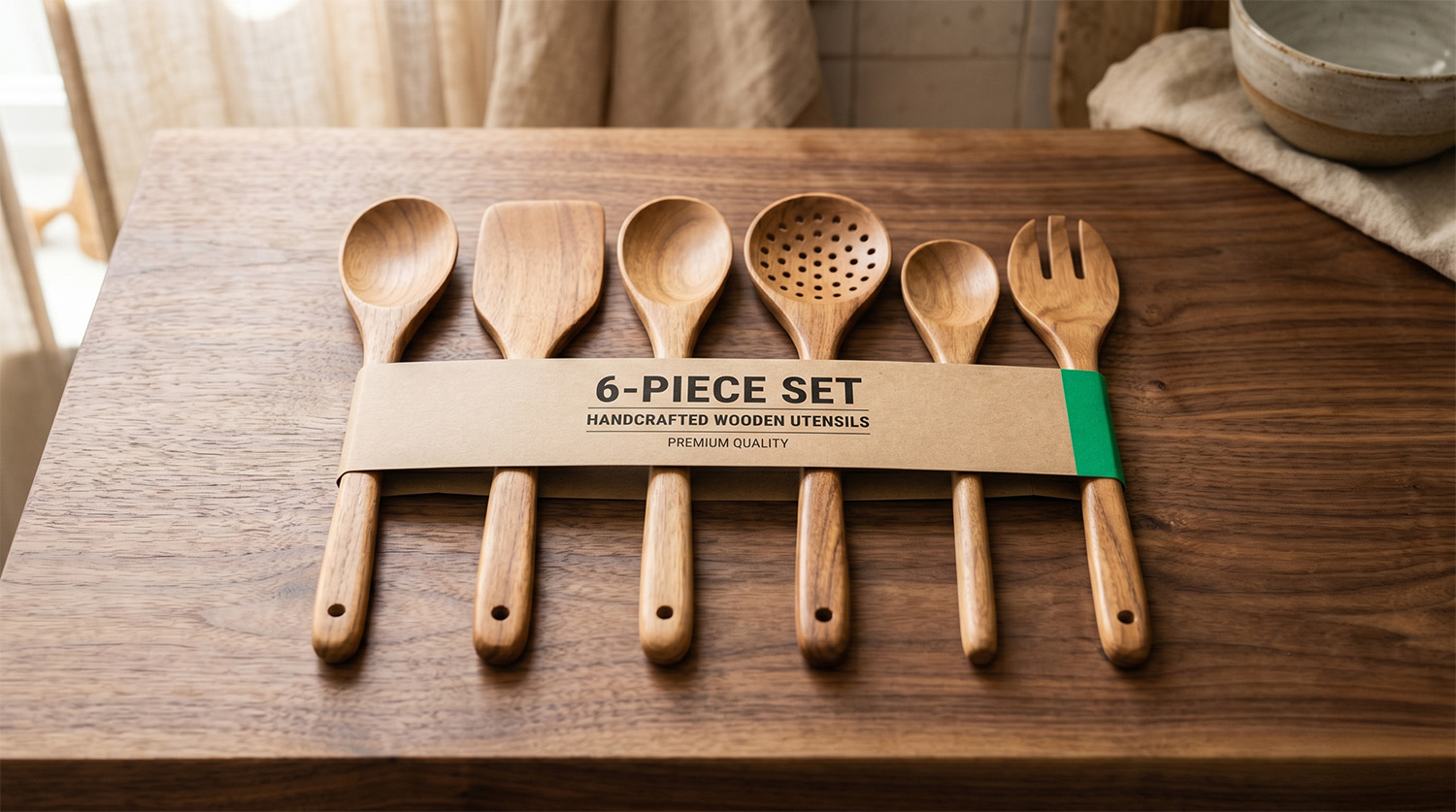
Bundles can take several shapes. They can be multiples of the same product — for example, buy two wooden spoons and get a third one free. They can also be a combination of multiple products — for example, a bundle containing a wooden spoon, turner, spatula, skimmer, mixing spoon, and salad fork.
Either of these bundle strategies allows you to increase your order value while offering the customer a better price per unit. Your customer pays less per unit, and you make more money overall.
To see why this works at the math level, we need to look at the six profit levers that move on every ecommerce sale:
- Product cost What you paid to have it made and shipped into your warehouse.
- Discounts Often used to convince strangers to buy from you because you do not have a big brand yet.
- Returns Not only the money the customer gets back, but also the cost of getting the item back into your warehouse and re-stocked.
- Warehousing and outbound shipping to the customer 3PL storage allocation, pick, pack, and the courier cost to the customer’s door.
- Ad spend to drive traffic to the online store Google Ads, Meta, and the rest of your paid channels.
- Payment processor and channel fees Combined at the platform’s rate — approximately 3% on Shopify and similar direct ecommerce, 15% on Amazon, Walmart and other marketplaces.
Five of these six levers stay almost flat whether the cart contains one product or six. Only the Product cost lever scales with units. That asymmetry is what makes bundles win. This article will show you how to set up your bundles for success.
1. Example showing you the numbers
Imagine you sell wooden kitchen utensils on Shopify. Your hero product is a hand-finished wooden spoon you retail at $20 per unit.
To keep your conversion rate healthy you run a standing 10% sitewide discount across the whole catalogue.
Over the course of a week, three different customers each arrive at your store and buy a spoon.
You make a total of $3 contribution.
Per-order math at 10% off
Same calculation runs three times — once per customer.
Now imagine you list a 3-pack of those wooden spoons as a bundle SKU at 20% off — twice the standing sitewide discount.
One customer arrives, sees the 3-pack and buys all three spoons in one order. The customer is delighted: they got an additional 10% saving on top of what they would have paid buying three single spoons.
And you? Well, you bank $9 of contribution instead of the $3 you would have made selling single spoons. That is a 3× in contribution despite giving away double the amount of discount. That is the power of bundles!
The wild bit is that it is the same product line. Same three spoons. But this one order absorbs the per-order costs once, not three times. One ad spend. One 3PL pick.
Bundle math at 20% off
Same three spoons, one order. Per-order costs apply once. Customer gets an extra 10% off.
The Bundle Model
Four scenarios side by side. The first two show the apples-to-apples comparison on three spoons — three customers at 10% off versus one customer with a 20% off bundle. The second pair shows the same comparison on six utensils at the same discount structure.
| Line Item | 3 separate single orders (10% off) | 3-pack bundle (20% off) | 6 separate single orders (10% off) | 6-piece bundle (20% off) |
|---|---|---|---|---|
| Number of orders | 3 | 1 | 6 | 1 |
| Units sold | 3 | 3 | 6 | 6 |
| Customer pays (total) | $54 | $48 | $108 | $96 |
| Customer extra saving vs BAU | n/a | $6 | n/a | $12 |
| Product (COGS) | $30 | $30 | $60 | $60 |
| Ad spend (× orders) | $9 | $3 | $18 | $3 |
| 3PL and outbound shipping (× orders) | $6 | $3 | $12 | $4 |
| Payment processor and channel fees (× orders, ≈3%) | $3 | $2 | $6 | $3 |
| Baseline returns (× orders) | $3 | $1 | $6 | $1 |
| Total cost | $51 | $39 | $102 | $71 |
| Founder contribution | $3 | $9 | $6 | $25 |
- The bigger the bundle set, the more margin you have to play with in terms of discount and the more money you stand to make.
- Bundles deliver more contribution to the founder AND more saving to the customer at the same time.
- Bundles eliminate per-order costs that would otherwise have been multiplied across separate orders.
The cost stack across all four scenarios
Each bar is the customer-paid revenue, broken into the cost layers from the bottom up. The green slice at the top is contribution. Notice how the bundle bars are shorter overall (customer pays less) but the green contribution slice is dramatically larger.
2. How to design a profitable bundle
Bundles are not so much a discount campaign as they are an order-consolidation strategy. The discount is what the customer sees. The eliminated per-order costs are what the founder banks. This is how you should treat them:
A bundle is a per-order cost saving in disguise.
The eliminated per-order costs are the value the bundle creates, and the founder gets to choose how to split that value between extra contribution and a deeper customer discount.
Six steps to design a bundle that scales contribution.
- Pick products customers already buy together. Look at your order history for items that co-occur in the same cart more than 8 to 10 percent of the time. For mixed bundles, this co-occurrence data is gold — it tells you which combinations the customer already wants. For multi-pack bundles, look at customers who reorder the same single unit within 30 days — they are telling you they would have bought the multi-pack if you had offered it.
- Test bundle size as a variable. Do not pick a bundle size by intuition. Run a 2-pack, a 3-pack, and a larger bundle (5-pack or 6-piece set) in parallel for two to four weeks. In most categories the optimal bundle size is bigger than the brand’s first instinct. Bigger bundles produce bigger per-order contribution; customers are often willing to commit to more units than you think.
- Model the contribution before you launch. Same six-lever model you would use on any campaign, with payment processor and channel fees combined at the platform’s rate — 3% for Shopify and similar direct ecommerce, 15% for Amazon, Walmart and other marketplaces. If contribution per order at the proposed bundle size and discount beats the separate-orders baseline, ship it. If not, change the bundle, change the discount, or kill the campaign at the model stage.
- Make sure the bundle’s per-unit price is lower than the single unit’s per-unit price. On Amazon and Walmart it is common to find 3-packs listed at a higher per-unit cost than the single. The customer notices. The conversion suffers. Always check the math from the customer’s perspective.
- Run a 2-week test before scaling. Watch the order count, the contribution per order, and the return rate. Bundle return rates sometimes run slightly higher than single-unit rates because the customer is less certain about committing to multiples. Make sure your model held up before you commit your inventory.
- If you are selling on a marketplace like Amazon, make sure you are the brand owner. You do not want to continually be fending off other sellers who try to undercut you on listings you created. The only way to do that is to join the Brand Registry.
3. Frequently asked questions
Multi-pack or mixed bundle: which strategy works best?
Both work, but they win different customer segments. Multi-pack bundles win with customers who already love your hero product and will use multiple units — think consumables, replenishment categories, gifts. Mixed bundles win with customers who are buying for a use case rather than a single product — think starter kits, completing a kitchen, themed sets. Most brands should run both. The multi-pack wins on the hero product’s repeat-buy base; the mixed bundle wins on first-time buyers who are buying for a category, not a SKU.
Won’t bundles cannibalise full-price single-unit sales?
This is the most common objection and it needs a real test, not a guess. Bundle buyers are usually a mix of two groups: customers who would have bought the same products one at a time across separate visits (cannibalised), and customers who would not have bought the full volume at all without the bundle value (incremental).
The cannibalised half is not pure cost. In our worked example, three separate single-unit orders at the standing 10% discount generate $3 of contribution; one 3-pack bundle at 20% off generates $9. Even if every bundle buyer would have come back to buy three single units individually, the founder still earns $6 more on that customer because the bundle absorbs per-order costs once instead of three times. The incremental half is pure win — the customer bought three units instead of one because the bundle made it appealing.
Run a controlled holdout test if you want certainty. Put the bundle in front of a randomised half of your traffic for two weeks. Compare total contribution per visitor against the held-out half. Most brands find the math works decisively in favour of bundling.
What if I sell on Amazon or Walmart instead of Shopify?
The bundle math still wins, but the cost stack shifts. On Shopify and similar direct ecommerce platforms, the combined Payment processor and channel fees line is roughly 3% of order revenue. On Amazon, Walmart, and other marketplaces, the same line is roughly 15% of revenue because the marketplace’s success fee includes the payment processing. That changes the headline contribution but not the structural insight: per-order costs still get multiplied when orders multiply, and bundles still consolidate them. Bundle SKUs on marketplaces should be enrolled in Brand Registry where possible — Brand Registry gives you control of the Buy Box so competing third-party sellers cannot undercut your bundle on the same listing.
Do I need separate SKUs for bundles or can I just combine in the cart?
Separate SKUs almost always win. In fact, on marketplaces they are essential. A dedicated bundle SKU lets you control the unit cost, the pack-out at the 3PL, the listing imagery, the customer-facing price, and the discount logic without affecting the single-unit SKU. Cart-based bundling (where the customer adds 3 units and a discount applies at checkout) is simpler to set up but messier in the books — the 3PL picks 3 separate units instead of 1 pre-packed bundle, channel fees apply differently, and tracking the bundle’s contribution becomes harder.
What if customers only want one item?
Keep the single unit available. The bundle is an alternative, not a replacement. Customers who want one will buy one and the founder still earns $1 of contribution per order at the standing 10% sitewide discount. Customers who see the bundle math and want the savings will buy the bundle and the founder will earn dramatically more. You want both segments converting — they just produce different per-order economics.
How deep should the bundle discount go?
Deep enough to be visibly better than the standing sitewide discount, but not so deep that it eats more contribution than the per-order cost savings created. Remember the goal is to make more profit. You want to give away as little as possible and make as much as possible, but it is a balancing act. The sweet spot is usually splitting the cost saving roughly evenly — half to the customer (a deeper discount), half to the founder (extra contribution). That keeps both sides happy and makes the bundle feel like a clear deal to the customer.
Can I stack bundle discounts with other promotions?
Be careful. Stacking discounts (a bundle discount on top of a sitewide promotion code, or both on top of an abandoned-cart code) is one of the most common ways founders accidentally turn a profitable bundle into a loss-making one. Run the contribution math on the worst-case stacked scenario, not just the bundle alone. If the stack still produces positive contribution per order, ship. If not, exclude bundle SKUs from sitewide promotions. In our Profit Playbook we cover the stacked-discount risk in more detail.
4. Quick reference: what to avoid and what to apply
- Comparing a bundle’s economics against a single-unit order — apples-to-apples means comparing against the equivalent number of single-unit orders at the standing sitewide discount.
- Running additional stacked discounts on top of your bundle discounts.
- Setting bundle size by intuition instead of testing 2-pack, 3-pack and larger bundles in parallel.
- Pricing the bundle at the same per-unit price (or higher) than the single unit.
- Treating bundles as discount campaigns rather than order-consolidation strategies.
- Launching a bundle without checking the contribution per order on the model first.
- Build a six-lever bundle model in Excel or Google Sheets before launch, with payment processor and channel fees combined into one line at the platform’s rate.
- Compare bundle contribution against the equivalent number of single-unit orders at the standing sitewide discount.
- Set the bundle discount deep enough to feel meaningfully better than the standing sitewide discount, but not so deep that it eats more than the per-order cost saving the bundle created.
- Pick bundle products from order-history co-occurrence (8 to 10 percent of carts).
- Test 2-pack, 3-pack, and larger bundles in parallel for two to four weeks.
- Use separate SKUs for bundles rather than cart-based bundling.
Definitions, modelling notes, and rate-basis disclosures
- Selling Price in this article is held at $20 per single unit (the wooden spoon) at full retail. With the standing 10% sitewide discount applied, the customer pays $18 per single unit at checkout. The 3-pack bundle at 20% off lands at $48 (from $60 retail). The 6-piece utensil set at 20% off lands at $96 (from $120 retail).
- The six profit levers in this framework: (1) Product (COGS — landed product cost per unit), (2) 3PL and outbound shipping, (3) Ad spend, (4) Returns, (5) Discounts, (6) Payment processor and channel fees (combined).
- Gross Profit equals Sell Price minus COGS.
- Contribution per Order is Sell Price minus all six lever costs. It is what is left to cover fixed costs (rent, salaries, software, founder pay) and profit.
- Per-order costs are the four cost lines that apply once per checkout regardless of unit count: Ad spend, 3PL and outbound shipping, Payment processor and channel fees, Baseline returns.
- Payment processor and channel fees is a combined line representing the platform-level fee structure. On Shopify and similar direct ecommerce platforms this is approximately 3% of revenue (Shopify Payments at 2.9% plus 30 cents per transaction). On Amazon, Walmart, and other marketplaces it is approximately 15% of revenue because the marketplace’s success fee includes payment processing.
- Multi-pack bundle is a bundle containing multiple units of the same product (for example, three wooden spoons).
- Mixed bundle is a bundle containing different but related products (for example, a 6-piece utensil set).
- Cannibalisation is the share of bundle sales that would have happened as separate single-unit orders without the bundle being available. Incremental sales are bundle sales that would not have happened at all without the bundle.
- All costs in the master table are stated as totals per scenario, with per-order costs multiplied by the number of orders the customer placed (3 for the three-spoon BAU, 6 for the six-utensil BAU, 1 for each bundle).
- The BAU scenario includes a 10% standing sitewide discount — this represents the realistic baseline state for most ecommerce brands rather than pure full-price selling.
- The bundle scenarios are offered at a deeper 20% discount — twice the standing sitewide rate. The deeper discount is what gives the customer a visibly better deal; the per-order cost amortization is what funds it.
- The wooden kitchen utensil profile used here has 50% COGS and 50% Gross Profit at full retail. Different categories use different ratios. Plug in your own.
- 3PL and outbound shipping scales modestly with bundle size — $2 single, $3 3-pack, $4 6-piece set — reflecting the slight increase in pick, pack and carton size as units increase.
- Payment processor and channel fees rounds to clean dollar values per the Shopify Payments formula (2.9% + 30 cents): $1 at $18, $2 at $48 and $54, $3 at $96 and $108.
- Product (COGS): $10 per unit at $20 retail. Held fixed per unit and scales linearly with bundle size.
- Ad spend: $3 per order. Held flat across all scenarios in this teaching model.
- 3PL and outbound shipping: $2 single, $3 3-pack, $4 6-piece set.
- Payment processor and channel fees: approximately 3% of revenue on Shopify (Shopify Payments at 2.9% plus 30 cents per transaction). Rounded to: $1 on $18 single, $2 on $48 3-pack, $2 on $54, $3 on $96 and $108.
- Baseline returns: $1 per order (roughly 5% of single-unit revenue at the standing 10% discount).