
The Problem with Treating Every Promotion as a Discount
When founders want to drive a campaign, they reach for the same lever every time: a percentage discount. Take 10% off, take 20% off, take 30% off. The customer pays less, the brand earns less, everyone moves on.
The trouble is that a cash discount is a one-to-one trade. A dollar of perceived saving for the customer is a dollar of foregone contribution for the brand. The mechanic has no leverage in it. What the customer feels is exactly what the seller pays.
A gift with purchase, designed correctly, breaks the one-to-one trade in the following ways:
- Increased perceived value: The customer perceives the gift at its retail value. The seller carries the gift at the Cost of Goods Sold (COGS) — typically thirty to forty percent of retail for consumables, and as low as twenty percent of retail for accessories. So one dollar of seller cost on a well-chosen Gift with Purchase (GWP) delivers three to five dollars of customer-perceived value. Same customer outcome. A third to a fifth of the campaign cost.
- Moving dead stock: The mechanic compounds further when the gift is sourced from slow-moving inventory. A seasonal Stock Keeping Unit (SKU) sitting at the Third-Party Logistics (3PL) facility is accruing holding fees every month. Used as a GWP gift, that sunk inventory turns into a conversion driver. The campaign cost falls to near zero, and you clear dead stock as a bonus.
- Increases average order value (AOV): The threshold does the third job. Setting a qualifying threshold above your current AOV — “Free gift on orders over $40” — pushes customers to add items to their cart to hit it. Those incremental items are revenue at near-full margin. The campaign is paid for by the AOV lift itself, not by your margin.
The math runs on the same six profit levers as any other campaign:
- Product cost What you paid to have it made and shipped into your warehouse.
- Discounts Often used to convince strangers to buy from you because you do not have a big brand yet.
- Returns Not only the money the customer gets back, but also the cost of getting the item back into your warehouse and re-stocked.
- Warehousing and outbound shipping to the customer 3PL storage allocation, pick, pack, and the courier cost to the customer’s door.
- Ad spend to drive traffic to the online store Google Ads, Meta, and the rest of your paid channels.
- Payment processor and channel fees Combined at the platform’s rate — approximately 3% on Shopify and similar direct ecommerce, 15% on Amazon, Walmart and other marketplaces.
The GWP touches three of these in your favour. The Product cost lever moves up slightly (the gift’s COGS), but a small move. The Discounts lever does not move at all — the headline price stays where it is. The 3PL lever moves up by the small pack-out bump on a three-item shipment. Against that, the revenue line climbs sharply because the threshold has pulled an incremental item into the cart. This article will show you how to design a GWP so the math works in your favour every time.
1. Example showing you the numbers
Imagine you sell premium soy candles on Shopify. Your hero product is a hand-poured 8-ounce candle you retail at $30 per unit. With your standing 10% sitewide discount applied, the customer sees $27 at checkout. The story walks through two campaign options for driving conversion: deeper discount, or a gift with purchase at a qualifying threshold of $40.
When the standing 10% no longer cuts through, founders often double down to 20% off, dropping the checkout price from $27 to $24.
Conversion lifts modestly. But every order now earns $3 of contribution instead of $6. Half your contribution per order absorbed for a small uplift in orders.
Worse, you have started teaching your audience to wait for the next 20% off campaign. The standing 10% no longer feels like a deal — and your customers will hold off until the next bigger sale.
Per-order math at 20% off
Same single-unit cart. Deeper discount. Half the contribution per order.
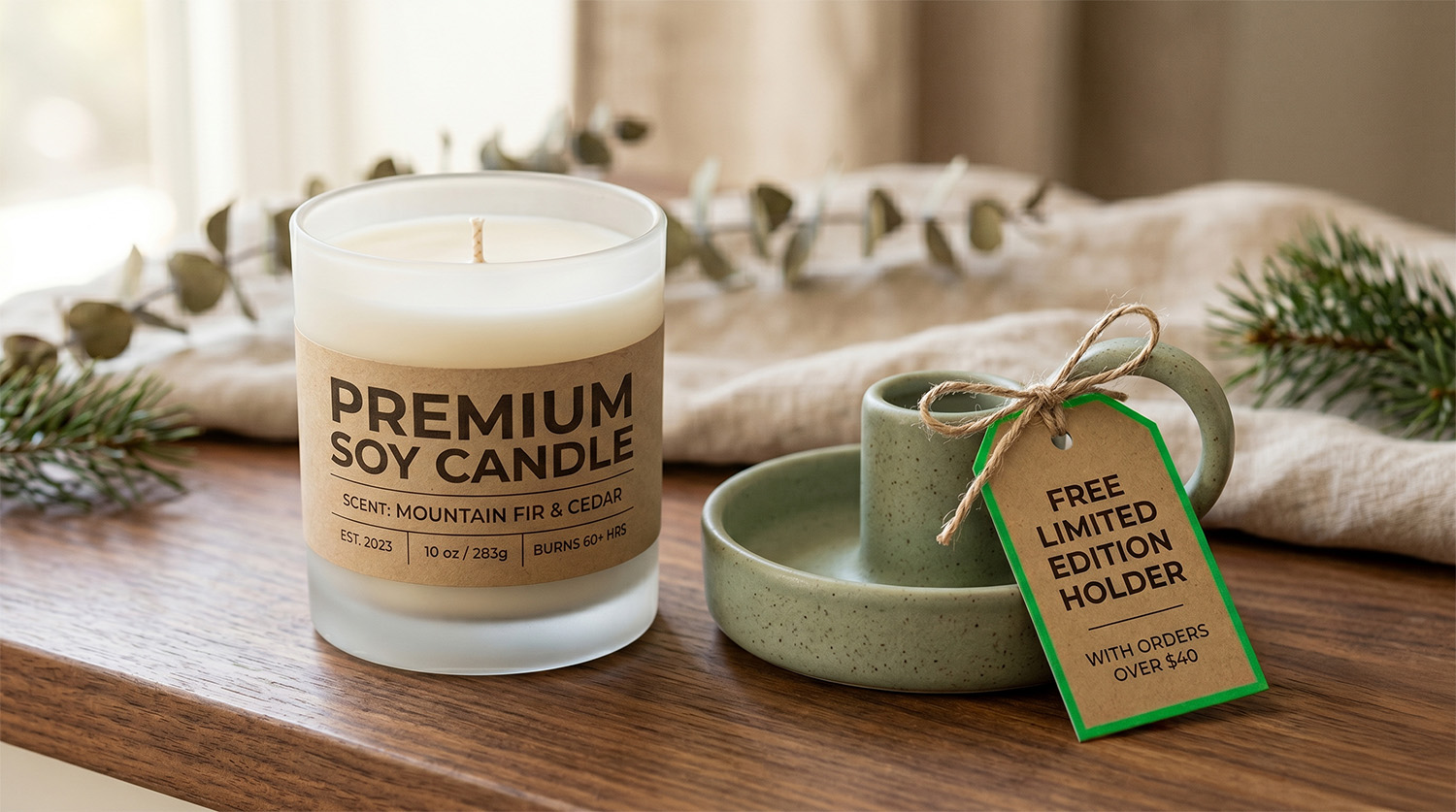
Instead of cutting the headline price, you leave the candle at its BAU $27 and put a banner on the product page and cart: “Free limited-edition ceramic candle holder ($15 retail) on orders over $40.” Your current AOV is $27, so the threshold sits about fifty percent above it.
A customer arrives to buy the hero candle. They see the gift offer at the cart — a holder they would actually want, not a sample of what they are already buying. They add a 4-ounce candle from your range — retail $14, paid at $12.60 with the 10% sitewide — to reach the threshold. Their final cart: $40 paid for two candles AND the free limited-edition holder.
The math turns. The customer perceives a free $15 holder they will keep on top of a $14 second candle they were on the fence about. Your seller cost on the holder is $3 — its COGS at the accessory-typical 20% ratio. The incremental contribution from the added second candle covers the holder COGS and the small 3PL bump several times over. Contribution per qualifying order climbs to $8, two dollars above BAU.
Per-order math with the GWP mechanic
Three-item cart at $40 paid. Holder drawn from regular stock. Threshold-driven AOV lift of 48% per qualifying order.
The Campaign Model
Four scenarios side by side. The first is Business As Usual (BAU) at the standing 10% sitewide discount. The next two are deeper discount campaigns. The fourth and fifth are GWP at a $40 threshold — once with a regular-stock limited-edition holder, and once with the same holder drawn from slow-moving inventory at zero marginal cost.
All values stated as totals per order. The GWP columns reflect a 3-item qualifying cart at $40 paid: the hero candle, a $14 added 4oz candle, and the free $15-retail limited-edition ceramic holder.
| Line Item | BAU 10% off (no campaign) | Campaign A: 20% off | Campaign B: 30% off | Campaign C: GWP regular-stock holder | Campaign D: GWP slow-moving holder |
|---|---|---|---|---|---|
| Cart contents | 1 hero candle | 1 hero candle | 1 hero candle | Hero + 4oz + free holder | Hero + 4oz + free holder |
| Customer pays at checkout | $27 | $24 | $21 | $40 | $40 |
| Customer-perceived campaign value | n/a | Saves $3 | Saves $6 | Free $15 holder | Free $15 holder |
| Product (hero candle COGS) | $12 | $12 | $12 | $12 | $12 |
| Product (added 4oz candle COGS) | — | — | — | $6 | $6 |
| Product (gift ceramic holder COGS) | — | — | — | $3 | $0 |
| Ad spend | $4 | $4 | $4 | $4 | $4 |
| 3PL and outbound shipping | $3 | $3 | $3 | $5 | $5 |
| Payment processor and channel fees (≈3%) | $1 | $1 | $1 | $1 | $1 |
| Baseline returns | $1 | $1 | $1 | $1 | $1 |
| Total brand cost | $21 | $21 | $21 | $32 | $29 |
| Brand contribution | $6 | $3 | $0 | $8 | $11 |
- Cash discounts not as effective as GWP: A cash discount trades dollar-for-dollar between perceived value and contribution. A GWP at a threshold breaks the trade — five dollars of perceived value for one dollar of seller cost when the gift is a high-margin accessory like a limited-edition holder.
- Perceived value of gift must be real: The gift must feel like an addition, not a downgrade. A sample of the hero product reads as a free taste; an accessory the customer will keep reads as a real gift. Choose accessories, limited-edition items, or complementary categories — not smaller versions of what they are already buying.
- Average order value must increase: The threshold is where the contribution lift actually comes from. The incremental item the customer adds to qualify covers the gift’s COGS many times over. Using slow-moving inventory takes the ratio from five-to-one to infinite AND clears dead stock from the 3PL.
The cost stack across BAU and the four campaign options
Each bar is the brand’s revenue, broken into the cost layers from the bottom up. The green slice at the top is contribution. The two GWP bars climb higher because the cart revenue ceiling has lifted from $27 to $40 — and the contribution slice grows along with it.
2. How to design a profitable GWP
A GWP is not a discount in disguise. It is a perception arbitrage funded by the gift’s wholesale-to-retail markup, layered on a qualifying threshold that pulls an incremental item into the cart at near-full margin. This is how you should treat them:
A cash discount is a one-to-one trade. A GWP at a threshold is a three-to-one to five-to-one trade in the seller’s favour.
Funded by the gift’s COGS and the incremental cart item, not by your margin. Combined with slow-moving inventory, the ratio climbs to infinite and clears dead stock at the same time.
Six steps to design a GWP that pays for itself.
- Set the qualifying threshold thirty to fifty percent above your current AOV. Same rule as the free shipping threshold. Too low and no customers add items; too high and almost no one qualifies. If your AOV is $27, the threshold belongs somewhere between $35 and $45 — somewhere a customer can hit by adding one accessible second item from your range.
- Pick a gift the customer would actually want, not a smaller version of the hero. A 4oz sample of an 8oz candle reads as a tease, not a gift. A limited-edition ceramic candle holder, a brass match cloche with long matches, or a vanilla incense starter kit reads as a real gift — something to keep, display, or use alongside the hero product. The gift category should complement the hero, not echo it.
- Pick gifts from the high-margin end of your catalogue. Accessory and decor categories typically carry twenty to twenty-five percent COGS, giving you a four-to-one or five-to-one perceived-value-to-cost ratio. Consumable gifts at thirty to forty percent COGS deliver three-to-one. If your gift has higher COGS than your hero, the campaign math compresses and a cash discount becomes more cost-competitive.
- Use slow-moving or end-of-season SKUs as the gift wherever you can. Inventory already sitting at the 3PL accruing holding fees has had its COGS paid months ago. The marginal cost of using it as a GWP gift is near zero. You convert a sunk holding cost into a conversion driver and clear dead stock in the same campaign.
- Anchor the gift’s perceived retail value clearly on the product page and at the cart. “Free limited-edition $15 ceramic holder on orders over $40” gives the customer three anchors: what the gift is, its standalone retail price, and the threshold to reach it. A vaguely-described complimentary gift with no price anchor reads as cheap regardless of what it actually is.
- Tier the gift if you want to push customers further up the value ladder. “Free $15 holder over $40, premium $30 incense and holder bundle over $80” gives customers a second target to aim for. Tiered GWP campaigns can lift AOV by an additional ten to fifteen percent over single-threshold campaigns when designed well.
3. Frequently asked questions
How do I pick the right threshold?
Look at your current AOV and add thirty to fifty percent on top. If your AOV is $27, your threshold belongs between $35 and $45. Most brands find the sweet spot around forty to fifty percent above AOV — high enough to drive a genuine add-on, low enough that a meaningful share of customers will reach it. Run the math two ways before you commit: at the lower threshold, conversion to the gift will be higher but AOV lift smaller; at the higher threshold, fewer customers qualify but each qualifying order is bigger.
What makes a gift feel valuable rather than cheap?
Three properties are important to ensure the gift does not seem like a downgrade:
- First, it is something the customer would keep, display, or use. Do not use samples of what they are already buying. A limited-edition ceramic candle holder reads as a real gift; a 4oz sample of an 8oz candle reads as a tease.
- Second, it has a clear standalone retail price the customer can point to. The perceived value is anchored in something real.
- Third, it ideally complements the hero product without echoing it. A holder for a candle, a snuffer set, a small incense starter kit. The gift extends the brand rather than miniaturizing it. Remember, if you sell candles and your gift is another candle, then one could argue that you are actually selling a bundle.
What if my gift has lower gross margin than my hero product?
The perceived-value-to-cost ratio depends on the gift’s gross margin. Accessories typically run at twenty to twenty-five percent COGS, delivering four-to-one to five-to-one ratios. Consumables run at thirty to forty percent COGS, delivering two-and-a-half to three-to-one. If your gift carries fifty percent or higher COGS, the ratio drops to two-to-one or worse — and a cash discount becomes more cost-competitive. Pick gifts from the high-margin end of your catalogue, or restrict GWP campaigns to high-AOV-lift thresholds where the incremental cart contribution carries the math.
What if I do not have any slow-moving inventory to give as gifts?
You can still run a GWP — the regular-stock version of the campaign earned eight dollars of contribution per order in the example above, still above BAU. The slow-moving variant takes the contribution per order from eight to eleven dollars and clears dead stock as a bonus. If you do not have slow-moving inventory, run the regular-stock version and look for opportunities to seed slow-moving SKUs (end-of-season samples, trade-show overruns, supplier sample programmes, limited-edition production overruns) for future campaigns.
Can I run a GWP and a discount at the same time?
Not without breaking the mechanic. The GWP’s contribution lift comes from the threshold pulling an incremental item into the cart at near-full margin. If you also discount the cart, you have given back the margin on the incremental item, and the gift’s COGS now eats into a smaller revenue base. Choose one or the other. If your goal is volume at thin margin, run a discount; if your goal is AOV lift at improved margin, run the GWP.
How does a Gift with Purchase differ from a bundle?
The two mechanics share a surface similarity — both involve multi-item carts and both lift AOV — but the underlying economics work in fundamentally different ways. A bundle reduces the headline price of a fixed combination of paid items; a GWP keeps headline prices flat and adds a free item triggered by cart size.
- What the customer chooses: A bundle is a pre-packaged SKU the brand has assembled in advance — “3-pack of candles for $75.” The customer takes the bundle or doesn’t. A GWP is the customer assembling the qualifying cart themselves — “spend $40 and pick what you want.” Bundle is take-it-or-leave-it; GWP is build-your-own.
- What is “free”: In a bundle, nothing is free. The customer pays one price for everything in the bundle; the deal is that the bundle price is lower than the sum of individual retails. In a GWP, one specific item — the gift — explicitly costs the customer zero. The other items are at full retail.
- Inventory implications: A bundle pulls the same SKU deeper from inventory — three of the hero. A GWP consumes a specific gift SKU per qualifying order, which is where the slow-moving-inventory angle becomes powerful. You can’t really liquidate dead stock through a bundle without contorting the SKU structure; with a GWP, dead stock IS the campaign.
- Where each works best: Bundles work best for consumable, repeat-purchase products where customers will use multiple units over time and the per-unit savings narrative lands cleanly. GWPs work best when you have a natural complementary accessory category (candles + holders, coffee + brewing accessories) or slow-moving inventory you want to clear.
How does this work on Amazon or Walmart?
Marketplace GWP is harder. Amazon does not have a clean native mechanism for bundling a free gift with a single SKU. Options include creating a bundle SKU that includes both products at a single price, using virtual bundles in Seller Central, or running the GWP as an inserted physical item in the shipment with a printed insert explaining it. On Walmart, similar constraints apply. The GWP mechanic is most powerful on your own Shopify or direct ecommerce store where you control the cart logic, the threshold, and the gift display.
4. Quick reference: what to avoid and what to apply
- Giving away a sample or smaller version of the hero product — it reads as a tease, not a gift.
- Running a GWP without a qualifying threshold — the gift’s COGS eats into your margin with no incremental revenue to cover it.
- Setting the threshold at or below current AOV — almost every customer qualifies without changing behaviour and the AOV lift never materialises.
- Picking a gift with low gross margin — the perceived-value-to-cost ratio compresses and cash discounts become competitive on cost.
- Stacking a discount on top of the GWP — the discount gives back the margin on the incremental item that funds the campaign.
- Hiding the gift terms in the footer rather than on the product page and at the cart.
- Pick a gift the customer would keep, display, or use — accessories, limited-edition items, or complementary categories.
- Set the qualifying threshold thirty to fifty percent above your current AOV.
- Pick gifts from the high-margin end of your catalogue (4:1 to 5:1 retail-to-COGS ratio).
- Use slow-moving or end-of-season inventory as the gift where you can.
- Anchor the gift’s perceived retail value with a clear standalone price on the product page and at the cart.
- Tier the gift to push customers further up the value ladder.
Definitions, modelling notes, and rate-basis disclosures
- Selling Price in this article is held at $30 per single unit (the premium soy candle) at full retail across all scenarios. The GWP scenario does NOT raise the headline price — the contribution lift comes from the threshold pulling an incremental cart item, not from the hero price moving.
- The six profit levers in this framework: (1) Product (COGS), (2) 3PL and outbound shipping, (3) Ad spend, (4) Returns, (5) Discounts, (6) Payment processor and channel fees (combined).
- Gift with Purchase (GWP) is a campaign mechanic where a free gift is added to qualifying orders above a defined threshold. The gift’s perceived retail value to the customer is the gift’s full retail price; the seller’s cost on the gift is its COGS. The gap between perceived value and seller cost is what makes the campaign more cost-efficient than a cash discount.
- Qualifying Threshold is the cart value above which the free gift triggers. Best practice is to set it thirty to fifty percent above current AOV so customers add items to qualify.
- Business As Usual (BAU) represents the brand’s baseline state — the standing 10% sitewide discount, no special campaign. The comparison anchor for evaluating any campaign mechanic.
- Average Order Value (AOV) is the average cart total per checkout. A GWP threshold’s job is to lift AOV by giving the customer a reason to add items to the cart.
- Cost of Goods Sold (COGS) is the landed product cost per unit — manufacturing plus inbound freight plus customs duty. Held at $12 for the hero candle and $3 for the $15-retail gift holder in this teaching model.
- Stock Keeping Unit (SKU) is a single distinct product line in the brand’s catalogue. A “slow-moving SKU” is one accruing 3PL holding fees because it is not selling at its expected velocity.
- Third-Party Logistics (3PL) is the outsourced warehousing and fulfilment provider. Charges include pick-and-pack labour per order plus storage allocation per month per SKU.
- Slow-moving inventory is stock the brand already holds at the 3PL with the COGS paid months ago. The marginal cost of using one extra unit in a GWP shipment is near zero — pick fee changes by cents at most.
- Contribution per Order is Sell Price minus all six lever costs. It is what is left to cover fixed costs and profit. The GWP mechanic is designed to raise contribution per qualifying order, not lower it.
- The GWP cart of $40 reflects a hero candle ($30 retail) plus a 4oz added candle ($14 retail), making $44 total retail. With the standing 10% sitewide discount applied, the customer pays $39.60, rounded to $40 for teaching clarity.
- The perceived-value-to-cost ratio in the strategic reframe assumes accessory gifts at twenty to twenty-five percent COGS (4:1 to 5:1 ratio). Consumable gifts at thirty to forty percent COGS deliver 2.5:1 to 3:1. The ratio scales with the gift’s gross margin — high-margin accessories make GWP shine; low-margin consumables narrow the gap with cash discounts.
- The slow-moving gift scenario holds the gift COGS at $0 because the inventory was already paid for and was accruing 3PL holding fees. If the inventory is not yet fully written off in your books, account for the GWP usage as inventory consumption at the original COGS for accounting purposes — but the marginal cash impact of including one extra unit in a shipment is near zero, which is what matters for campaign design.
- 3PL and outbound shipping is held at $5 on the 3-item GWP cart versus $3 on the BAU single-item cart. The two-dollar bump reflects the additional pick-and-pack labour and slightly heavier packaging required for three units in one box.
- Returns is held flat at $1 across all scenarios for teaching simplicity. In production, GWP carts may carry slightly higher absolute return cost because there are more items in the box, but the return RATE often falls modestly because customers who received a gift feel more generously treated. The net effect tends to be roughly flat.
- The premium candle profile used here has 40% COGS and 60% Gross Profit at full retail. Different categories use different ratios.
- Product (hero candle COGS): $12 per unit at $30 retail (40% COGS).
- Product (added 4oz candle COGS): $6 per unit at $14 retail (~43% COGS).
- Product (gift ceramic holder COGS): $3 per unit at $15 retail (20% COGS, accessory-typical) in the regular-stock GWP scenario. $0 marginal in the slow-moving GWP scenario.
- Ad spend: $4 per order — modestly higher than mass-market because premium candles typically attract higher ad CPMs. Held flat per ORDER, not per item, because the ad acquired the order, not each unit.
- 3PL and outbound shipping: $3 per order on single-item BAU and discount carts; $5 per order on 3-item GWP carts to reflect the pack-out bump.
- Payment processor and channel fees: approximately 3% of revenue on Shopify (2.9% plus 30 cents per transaction). Rounded to nearest dollar across scenarios for teaching clarity.
- Baseline returns: $1 per order in this teaching model, held flat across scenarios for the reasons noted in modelling notes.