
The Problem with Pricing Every SKU at the Catalog-Blended Refund Rate
When founders model SKU margins, they apply a single refund rate to every product. The catalog-blended number — typically the only refund rate the dashboard surfaces — gets baked into the per-Stock Keeping Unit (SKU) margin calculation. Hero SKUs and problem SKUs get the same returns assumption. The result is a finance dashboard that shows every SKU as comfortably profitable.
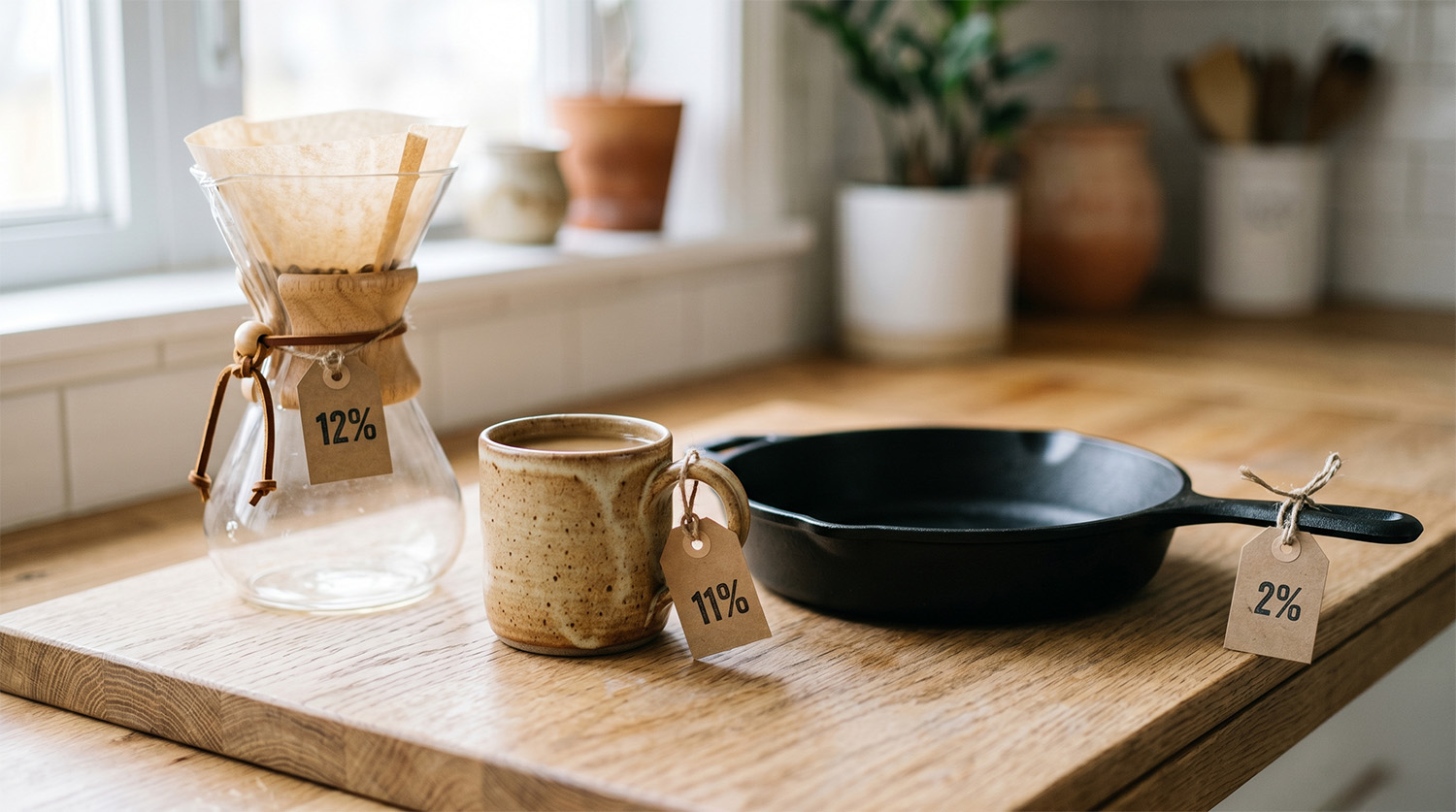
Individual SKU return rates can vary by 4 to 6 times across the same catalog. A 12 percent SKU and a 2 percent SKU have fundamentally different unit economics — over $5 of contribution difference per order on a $50 product.
The high-return SKUs are usually the ones that look most profitable on the dashboard. Their gross margin is intact, so they keep appearing in the “hero SKU” reports. The refund cost is hiding in the operating-cost line of the catalog blend.
A $50 refund actually drains $64 from your business. Beyond losing the $50 sale, you permanently lose the $8 spent on ads to acquire that customer, $3 for return shipping, $1 in Third-Party Logistics (3PL) restocking, and $2 of channel fees on the refunded amount. Founders who only watch the Returns line on their Profit and Loss (P&L) systematically underestimate this lever.
The math runs on the same six profit levers as any other campaign:
- Product cost
- Discounts
- Returns
- Warehousing and outbound shipping
- Ad spend
- Payment processor and channel fees
The Returns lever is the only one that varies meaningfully between SKUs at the same price point. Product cost, 3PL, ad spend, and channel fees are roughly flat across a catalog. The Returns lever is where the effective-margin math diverges.
1. Example showing you the numbers
Imagine you sell premium kitchenware on Shopify. Your catalog has 60 SKUs across three product families — coffee accessories, drinkware, and cookware. All are priced at $50 Average Order Value (AOV), all with the same 60 percent gross margin. Your finance dashboard reports a catalog-blended refund rate of 4 percent — bang on the kitchenware category benchmark from the National Retail Federation (NRF). You have been using that 4 percent in every per-SKU margin model. The story walks through two approaches: the catalog-blended model you have been using, and a SKU-level effective margin model that surfaces the real economics on each individual product.
You build the per-SKU margin model in Excel using the 4 percent catalog-blended refund rate. Every SKU gets the same $2 returns line. Every SKU shows an effective contribution of $13 per order.
Two of your bestsellers — the hand-thrown ceramic mug and the glass pour-over coffee maker — keep showing up in hero SKU reports. They are featured in every campaign because the model says they are highly profitable.
The reality is hidden in the operating-cost line of the catalog blend. The model gives you no signal that anything is wrong, because every SKU is assumed to refund at the same rate.
Per-SKU math at the catalog-blended assumption
Every SKU gets the same 4% returns line. Every SKU appears equally profitable.
You pull 90 days of refund data, sorted SKU by SKU. The dispersion is dramatic — but with one pleasant surprise.
Your hero sauté pan runs at just 2 percent returns — well below the catalog blend. Apply the SKU’s actual 2% rate to its returns line (instead of the assumed 4%) and the effective contribution jumps from $13 to $14 per order.
The sauté pan is quietly worth more than the dashboard shows. It is a candidate for MORE marketing investment, not less — the catalog-blended model has been understating its profitability.
Per-SKU math: Hero sauté pan at 2% returns
Same cost stack as the blended model. Only the returns line changes.
Two other SKUs — the hand-thrown ceramic mug and the glass pour-over coffee maker — run at 12 percent returns each. Three times the catalog blend, hidden inside the average.
Apply the actual 12% rate to either SKU’s returns line and the effective contribution drops from $13 to $9 per order. A $4 shortfall per order that no margin report surfaces because the dashboard uses the catalog blend.
With 200 monthly orders on each item, this mistake creates an $800 monthly blind spot per product ($9,600 a year per SKU). Combined, these two problem SKUs quietly cost your business over $19,000 a year in lost profits. Two fixes follow: reprice both to about $54, OR redesign the product pages and packaging.
Per-SKU math: Ceramic mug at 12% returns
Same cost stack as the blended model. Only the returns line changes — and the change is dramatic.
The Effective-Margin Model
The table below compares four SKUs from the catalog plus the catalog-blended reference row. Same $50 sell price, same $20 COGS, same operating costs. Only the returns line differs based on each SKU’s actual refund rate.
Margin-before-returns baseline = $15 ($50 - $20 COGS - $8 ad - $5 3PL - $2 channel). Effective contribution = $15 baseline minus the SKU’s specific returns cost. All figures rounded to the nearest dollar.
| SKU | Hero sauté pan | Mid travel mug | Catalog blended | Ceramic mug | Pour-over coffee maker |
|---|---|---|---|---|---|
| Selling price | $50 | $50 | $50 | $50 | $50 |
| Product cost (COGS) | $20 | $20 | $20 | $20 | $20 |
| Ad spend | $8 | $8 | $8 | $8 | $8 |
| Outbound 3PL and shipping | $5 | $5 | $5 | $5 | $5 |
| Channel fees (~4%) | $2 | $2 | $2 | $2 | $2 |
| Margin-before-returns baseline | $15 | $15 | $15 | $15 | $15 |
| SKU’s actual refund rate | 2% | 6% | 4% | 12% | 12% |
| Returns line at SKU rate | -$1 | -$3 | -$2 | -$6 | -$6 |
| Effective contribution per order | +$14 | +$12 | +$13 | +$9 | +$9 |
Effective contribution per order across the five SKU profiles
The catalog-blended assumption ($13) sits in the middle. Actual SKUs range from $9 (problem SKUs) to $14 (hero SKU). Pricing every SKU as if it earned the catalog-blended contribution overstates two SKUs by $4 each.
2. How to build a SKU-level effective margin model
A SKU-level effective margin model is an Excel exercise that takes about two hours to build. The output is a table that surfaces which SKUs are dragging the catalog blend down and which are quietly earning more than the dashboard says.
Five steps to build a SKU-level effective margin model.
- Pull 90 days of SKU-level refund data. Sort high-to-low by refund rate per SKU. Filter out SKUs with fewer than 20 units sold in the window — the rate is too noisy to act on.
- Build the SKU-level cost stack in your model. Per-SKU rows include sell price, COGS, ad spend, 3PL, channel fees, and returns at the SKU’s actual rate. Sum to a per-SKU effective contribution.
- Flag any SKU more than 20 percent below the catalog-blended contribution. Those are candidates for repricing, redesign, or retirement. Also flag any SKU more than 20 percent above the blend — quiet heroes that may deserve more marketing investment.
- Pick the right fix per SKU. Repricing makes sense when the product is good but the price does not reflect its true cost profile. Redesign (photos, sizing, packaging, product page content) makes sense when the customer is buying the wrong thing or using it incorrectly.
- Re-run the model quarterly. Refund rates drift. New SKUs enter the catalog. Set a recurring 90-day model refresh and act on the new flags.
3. Frequently asked questions
How big does my catalog need to be for SKU-level effective margin to matter?
Below 20 SKUs, the catalog-blended model is usually fine. Between 20 and 100 SKUs, SKU-level effective margin starts to surface meaningful dispersion. Above 100 SKUs, you almost certainly have SKUs running at 3x to 6x the blended rate and the model is mandatory.
What is the right benchmark refund rate for my category?
The NRF and Statista publish category benchmarks every year. Kitchenware sits around 3 to 5 percent. Apparel runs at 12 to 24 percent depending on subcategory. Beauty runs at 5 to 8 percent. Home goods 8 to 12 percent.
Does this work for Amazon sellers?
Yes. The Amazon SKU-level refund picture comes from a combination of Return Reports by Amazon Standard Identification Number (ASIN), the Customer Concession Rate metric in Account Health, and the Voice of the Customer (VOC) dashboard. Build the effective contribution model on each ASIN’s actual rate.
What if I do not know my real ad cost per SKU?
Use blended ad cost as a starting point. Pull total ad spend over 90 days, divide by total orders, and apply that average to every SKU. The model is still useful because the Returns lever is the dominant variance between SKUs.
Should I just retire the high-return SKUs?
Not as a first move. The high-return SKUs are often high-volume revenue contributors and may bring in customers who go on to buy other SKUs. Try repricing first. Try product-page redesign per Article 1 of this Refunds series.
How does this interact with bundles, Gift with Purchase (GWP), or subscriptions?
All three mechanics tend to lower the refund rate at the cohort level, but the per-SKU dispersion remains. Build the effective-margin model on the underlying SKU rates first; layer the bundle, GWP, or subscription mechanics on top.
What price increase do I need to make a high-return SKU healthy again?
Solve for the price that produces $12 to $13 of effective contribution at the SKU’s actual refund rate. The calculation is simple. Take your new price, subtract your operating costs, and subtract your updated return costs. The remaining amount is your true profit per order. For a SKU at 12 percent returns and $9 effective contribution at $50, the right price is around $54 to $55.
4. Quick reference: what to avoid and what to apply
- Applying the catalog-blended refund rate to every SKU’s margin model.
- Trusting the “hero SKU” report from your dashboard at face value.
- Pricing every SKU the same way regardless of its actual refund rate.
- Retiring a high-return SKU without trying repricing or redesign first.
- Building the model once and never refreshing it.
- Ignoring quiet heroes (SKUs running well below catalog blend).
- Using only refund rate for the audit — sort by refund DOLLARS as well.
- Pull 90 days of SKU-level refund data and filter out low-volume SKUs.
- Build the per-SKU cost stack with the SKU’s actual refund rate applied.
- Calculate effective contribution per order at the SKU level.
- Flag SKUs more than 20 percent below the catalog-blended contribution.
- Flag SKUs more than 20 percent above the blend as quiet heroes.
- Choose the right fix per SKU: reprice, redesign, or retire.
- Re-run the model every 90 days as the catalog evolves.
Definitions, modelling notes, and rate-basis disclosures
- Average Order Value (AOV) is held at $50 per order — representative of mid-tier kitchenware Direct-to-Consumer (D2C).
- The six profit levers: (1) Product, (2) 3PL and outbound shipping, (3) Ad spend, (4) Returns, (5) Discounts, (6) Payment processor and channel fees. Detailed lever descriptions live in the discounts-1 Playbook article.
- Business as usual (BAU) is the catalog-blended margin model with 4 percent refund rate applied uniformly to every SKU.
- Stock Keeping Unit (SKU) is a single distinct product line in the brand’s catalogue.
- Cost of Goods Sold (COGS) is the landed product cost per unit. Held at $20 per unit (40% COGS at $50 retail).
- Third-Party Logistics (3PL) is the outsourced warehousing and fulfilment provider.
- Profit and Loss (P&L) is the brand’s financial statement of revenue and operating costs.
- Catalog-blended refund rate is a single refund rate calculated across all SKUs, weighted by revenue or units.
- Effective contribution per order is per-SKU contribution with the SKU’s ACTUAL refund rate applied.
- Margin-before-returns baseline is sell price minus COGS minus the four non-returns operating cost lines. On this article’s $50 hero: $15.
- National Retail Federation (NRF) publishes annual refund-rate benchmarks by category.
- Voice of the Customer (VOC) is the Amazon Seller Central dashboard.
- Amazon Standard Identification Number (ASIN) is Amazon’s per-SKU identifier.
- Gift with Purchase (GWP) is a campaign mechanic where a free gift is added to qualifying orders.
- All per-order costs are stated per customer checkout. The Returns line scales with the SKU’s actual refund rate.
- SKU-level rate dispersion (2 percent on heroes vs 12 percent on problem SKUs) is typical of kitchenware and home-goods catalogs.
- Math reconciliation: every effective contribution figure = $15 margin-before-returns baseline minus the SKU’s returns cost.
- The full refund event cost on a $50 order is $64 ($50 + $3 reverse-ship + $1 restock + $8 lost ad spend + $2 channel fees on the refunded amount).
- Kitchenware category baseline: 4 percent refund rate.
- Channel fees: 4% of sell price ($2 on the $50 AOV).
- Ad spend: $8 per order at full price.
- Outbound 3PL and shipping: $5 per outbound order.
- Margin-before-returns baseline: $50 - $20 - $8 - $5 - $2 = $15.
- Returns cost per order at SKU rate: $50 × rate, rounded to the nearest dollar.