
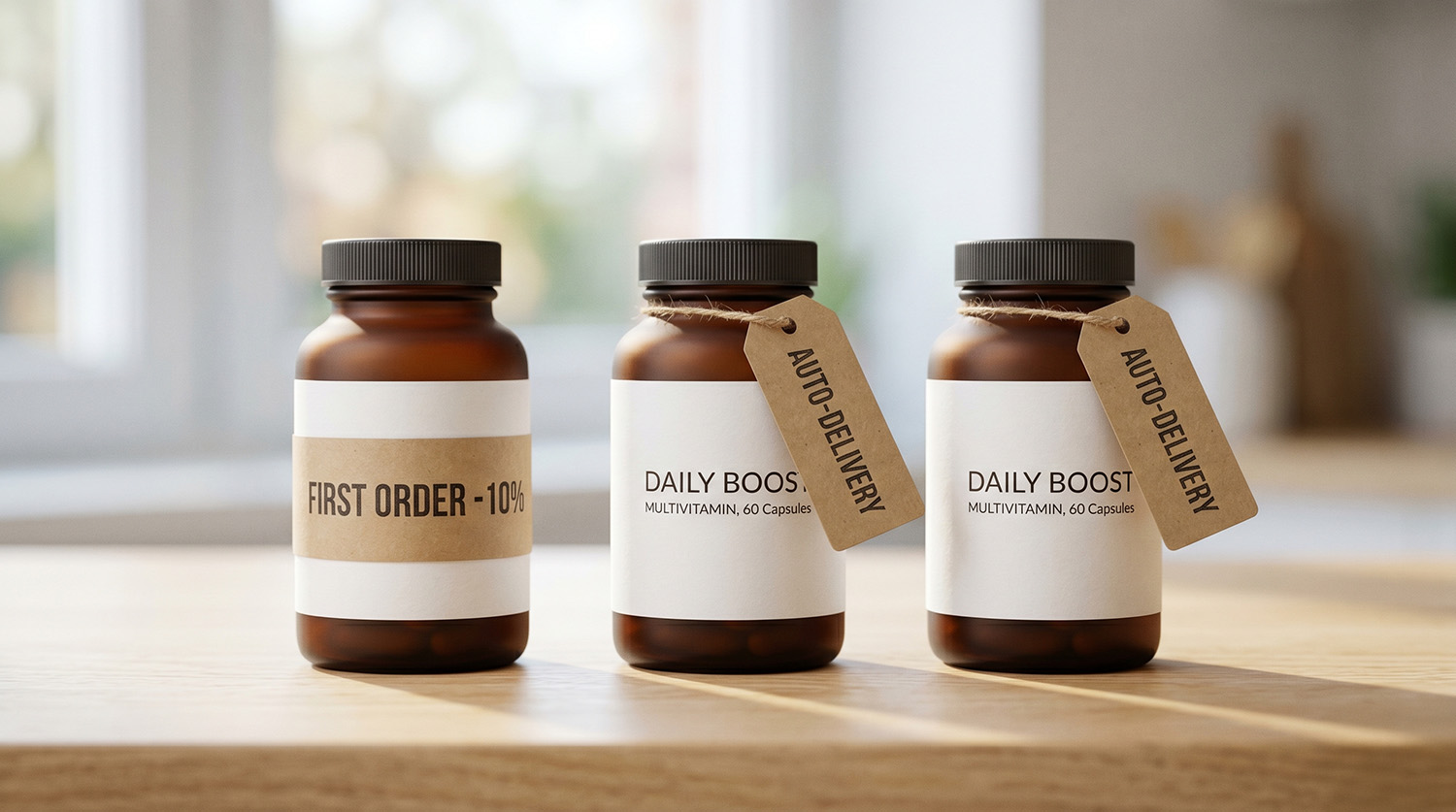
The Problem with Looking at Subscriptions on a Per-Order Basis
Many founders reject subscription models because a 10 to 20 percent discount slashes their immediate margins. But evaluating a subscription on a single order is a mistake.
The per-order math is the wrong frame. The right frame is the twelve-month net contribution per customer you will earn. With a subscription, profit is calculated over the lifetime of the customer, not just at initial purchase.
A subscription discount, designed correctly, builds lifetime contribution in three layers:
- Order 1 is thin — and may be a small loss: The Customer Acquisition Cost (CAC) plus the subscription discount squeezes order 1 to near zero. In this article’s worked example, order 1 lands at $1 of contribution. With slightly deeper discount or higher CAC, order 1 flips to a small loss. That is fine — the recurring orders cover it inside one month.
- Orders 2 through 12 each earn double the standalone contribution: From order 2 onwards, no new CAC hits the order. Each recurring delivery earns $26 of contribution. The same customer on a single standalone sale earns the brand $12. The recurring relationship is more profitable per order than the one-time sale, even with the subscription discount in place.
- Twelve months of recurring orders dwarf the standalone alternative: Across twelve monthly orders the subscriber generates $287 of cumulative contribution — twenty-four times the standalone customer’s $12. Even with realistic churn at month 6, the subscriber still banks $131 — eleven times the standalone. The thin order 1 is the price of admission to a customer relationship worth far more than the single sale.
The math runs on the same six profit levers as any other campaign:
- Product cost What you paid to have it made and shipped into your warehouse.
- Discounts Often used to convince strangers to buy from you because you do not have a big brand yet.
- Returns Not only the money the customer gets back, but also the cost of getting the item back into your warehouse and re-stocked.
- Warehousing and outbound shipping to the customer 3PL storage allocation, pick, pack, and the courier cost to the customer’s door.
- Ad spend to drive traffic to the online store Google Ads, Meta, and the rest of your paid channels.
- Payment processor and channel fees Combined at the platform’s rate — approximately 3% on Shopify and similar direct ecommerce, 15% on Amazon, Walmart and other marketplaces.
Four levers stay flat between a standalone single-sale and a subscriber’s recurring order. Product cost, 3PL, payment processor and returns are essentially identical per order. The Ad spend lever is the one that changes — paid once to acquire the customer, then zero for every recurring order that follows. This article will show you how to price subscribe-and-save so the twelve-month LTV comfortably exceeds the standalone single-sale.
1. Example showing you the numbers
Imagine you sell premium multivitamins on Shopify. Your hero product is a 30-day bottle you retail at $60 per unit. Your standalone customer pays the full $60. Your subscribe-and-save offer gives subscribers 20% off, so they pay $48 per bottle every month. The story walks through two acquisition paths: a standalone customer who buys once, and a subscriber whose recurring orders capture twelve months of contribution.
A customer clicks an ad, picks up a bottle at full retail $60, pays, and leaves.
The math on a single sale is straightforward. Your $60 retail price covers product, shipping, and upfront ad spend, leaving a clean $12 profit.
It is sustainable, but it leaves long-term value on the table — there is no recurring relationship.
Per-customer math at standalone single-buy
One bottle. Full retail. Full acquisition cost.
The same ad-click customer chooses Subscribe & Save: $48 per bottle, 20% off retail, monthly delivery.
Order 1 lands at $1 of contribution after the $25 CAC. Orders 2 through 12 each earn $26 because the CAC was paid once.
Across the year the subscriber generates $287 of cumulative contribution — twenty-four times the standalone customer’s $12.
Per-customer math at subscribe-and-save
12 monthly orders. Ad spend paid once. Recurring contribution at $26 per order.
The Subscriber Model
Five scenarios side by side. The first is the standalone single-buy customer at full retail. The next three break down the subscriber’s economics at order 1 (carries acquisition cost), orders 2-12 (per recurring order), and the 12-month cumulative LTV. The last is a realistic churn case where the subscriber cancels at month 6.
Values stated as totals per order for the per-order rows, and cumulative across the lifetime for the LTV rows. The 12-month subscriber column assumes no churn for teaching clarity; the 6-month churn column shows what happens if the subscriber cancels after six orders.
| Line Item | Standalone single-buy (full retail) | Subscriber order 1 | Subscriber order 2+ (each) | Subscriber 12-month LTV (no churn) | Subscriber 6-month LTV (50% churn) |
|---|---|---|---|---|---|
| Orders per customer | 1 | 1 | 1 (recurring) | 12 | 6 |
| Customer pays per order | $60 | $48 | $48 | $48 each | $48 each |
| Product (COGS) | $15 | $15 | $15 | $180 | $90 |
| Ad spend (acquisition only) | $25 | $25 | $0 | $25 | $25 |
| 3PL and outbound shipping | $5 | $5 | $5 | $60 | $30 |
| Payment processor and channel fees (≈3%) | $2 | $1 | $1 | $12 | $6 |
| Baseline returns | $1 | $1 | $1 | $12 | $6 |
| Total brand cost | $48 | $47 | $22 | $289 | $157 |
| Brand contribution | +$12 | +$1 | +$26 | +$287 | +$131 |
Think of the first order’s discount as a marketing cost to lock in eleven more months of high-margin revenue. Future orders fund the initial discount.
Each recurring order earns more than double a standalone single-sale, because the acquisition cost was paid once and never paid again. Optimise on twelve-month LTV by cohort — not on order-1 contribution.
Cumulative contribution per customer across twelve months
The standalone customer banks $12 once and stops. The subscriber starts at $1 in month 1 and climbs by $26 each month. The two lines cross during month 2 — and by month 12 the subscriber is 24 times higher than the standalone.
2. How to price a profitable subscription
A subscription discount is a deal between the brand and the customer. The customer agrees to a recurring relationship in exchange for a meaningful per-order saving. The brand agrees to a thin order 1 in exchange for eleven more orders of full-margin contribution.
Six steps to price a subscription that pays for itself.
- Sell the standalone product at full retail. No sitewide discount, no bundle pricing on the single unit. The standalone customer pays the full price — and the brand earns a clean per-customer contribution on that sale. The full-retail price is also the anchor that gives the subscription discount its perceived value. If standalone customers already get a discount, the subscription saving is smaller in contrast and feels less compelling.
- Set subscribe-and-save at 10 to 20 percent off full retail. Too shallow and few customers enrol; too deep and order 1 may lose more money than the recurring orders comfortably recover. The 20 percent off example in this article keeps order 1 just above zero. If you want a deeper discount, raise the retail or accept a small order 1 loss that the recurring orders recover within one cycle.
- Verify the cumulative break-even by month 2 or 3. With order 1 at or near zero and orders 2-12 each earning full margin, the cumulative contribution should cross into positive territory within the first two recurring orders. If the breakeven extends past month 4, the discount is too deep, the retail is too low, or your CAC is too high. Model this before launch.
- Make subscription the default at checkout. The customer has to actively unselect subscribe-and-save to choose one-time. Defaults move conversion dramatically — well-designed flows convert 30 to 50 percent of customers into subscribers when the subscription is the default option.
- Track subscriber retention by acquisition cohort. The metric that matters is what percentage of customers acquired in a given month are still subscribed at three, six, and twelve months. Churn between months 1 and 3 is usually the steepest part of the curve — if more than 40 percent of subscribers cancel before order 3, the product or the onboarding experience needs work.
- Reactivate churned subscribers with a one-month return offer. A subscriber who churned at month 4 is not the same as a brand-new customer — they have already validated the product. A targeted “come back for one month at $40” offer often re-activates the subscription cleanly. The CAC has already been paid, so the return offer can be aggressive without breaking the unit economics.
3. Frequently asked questions
Why does the standalone product not get the 10 percent sitewide discount?
Because the subscription discount depends on a contrast against full retail. If the standalone customer already gets 10 percent off ($54), then a subscription at 20 percent off ($48) is only a $6 saving compared to standalone — and the contrast is weak. By holding standalone at full retail $60 and reserving the discount exclusively for subscribers, the saving climbs to $12 per bottle ($144 across the year), which is meaningful enough to drive enrolment. The discount is most valuable when it is reserved for the customers committing to a recurring relationship.
What if my product is not naturally consumable?
Subscription works best on consumables — things customers use up and need to buy again. Vitamins, coffee, pet food, protein powder, household consumables, skincare, haircare. The mechanic only works when the customer has a natural reason to buy the same product every month. You would not run a subscription on wooden spoons because customers do not need a new set every month. For non-consumables, a curated discovery box can still work — a fashion brand offering a quarterly apparel drop, a coffee brand offering a different single-origin every month — but the mechanic shifts from replenishment to discovery.
How deep should the subscription discount be?
Run the math two ways before you commit. At 10 percent off, you preserve more order 1 margin but enrolment will be lower. At 20 percent off, enrolment is stronger but order 1 sits at or near zero. The optimal point maximises total programme contribution across all acquired subscribers, not per-subscriber LTV in isolation. Most categories find the sweet spot between 15 and 20 percent off.
What if subscribers churn after just one or two orders?
An early-churn subscriber is thinner than a standalone customer because the subscription discount means order 1 earns less than a full-retail sale. If more than 40 percent of your subscribers cancel before order 3, the programme may be destroying value relative to selling standalone. Look at three things: the onboarding experience (do subscribers know what to expect), the product (does the customer actually want it monthly), and the cancellation flow (are customers cancelling because of friction with the subscription mechanic, not the product itself). Fix these before scaling enrolment.
Can I offer different discount tiers for annual versus monthly?
Yes. Annual prepay at a deeper discount (20 to 25 percent off) is a powerful upgrade for subscribers who have stuck through three or four monthly orders. The annual customer has effectively prepaid the lifetime value upfront, eliminating churn risk for the duration. Offer the annual upgrade once the monthly subscriber has demonstrated commitment — the conversion rate on a sixth-month annual upgrade offer is typically much higher than on a first-month offer.
How does subscription compare to bundles and GWP campaigns?
All three boost revenue, but they pull different financial levers. Bundles discount a fixed group of items to spread per-order fixed costs across multiple units in one shipment. A Gift with Purchase (GWP) keeps headline prices flat and uses the gift’s wholesale-to-retail markup at a qualifying threshold to pull an incremental cart item. A subscription discounts a recurring relationship to spread acquisition cost across the customer’s lifetime. Bundles and GWP boost a single order; subscriptions boost the customer relationship. They coexist cleanly: a subscriber can still receive a GWP campaign on order 8, layering AOV lift on top of LTV.
What about Amazon Subscribe and Save?
Amazon’s Subscribe and Save costs the brand 5 to 10 percent on top of the standard Fulfilled by Amazon (FBA) fees and lifts customer perceived value through Amazon’s branded badge. The economics are similar to direct subscription with a roughly 5 percent fee drag. The main caveat is that you do not own the customer relationship — Amazon controls the data, the renewal cadence, and the cancellation flow. For brands building toward direct-customer LTV, native Shopify subscription is the stronger play even though Amazon Subscribe and Save can drive incremental volume.
4. Quick reference: what to avoid and what to apply
- Evaluating a subscription programme on order 1 contribution alone — the recurring orders are where the value lives.
- Discounting the standalone product — it erodes the contrast that makes the subscription saving feel meaningful.
- Setting subscribe-and-save too shallow (under 10 percent) — few customers enrol and the programme does not scale.
- Setting subscribe-and-save too deep (over 25 percent) — the cumulative breakeven extends past month 3 and the LTV math thins.
- Hiding the subscription option behind a click — defaults move conversion dramatically.
- Ignoring first-90-day cohort retention — this is where the biggest churn happens and the biggest leverage on programme economics lives.
- Treating a churned subscriber as a brand-new customer — they have already validated the product and should be reactivated specifically.
- Sell the standalone product at full retail. No sitewide on the single unit.
- Set subscribe-and-save at 10 to 20 percent off retail.
- Verify cumulative breakeven by month 2 or 3 before launch.
- Make subscription the default at checkout.
- Track cohort retention at 3, 6, and 12 months — watch early-churn especially.
- Reduce first-90-day churn with onboarding emails, shipping flexibility, and proactive customer service.
- Reactivate churned subscribers with a targeted one-month return offer.
Definitions, modelling notes, and rate-basis disclosures
- Standalone retail in this article is held at $60 per single unit (the multivitamin bottle) at full retail with NO sitewide discount. The standalone customer pays the full $60. The subscriber pays the subscribe-and-save price of $48 per bottle (20% off full retail). The article deliberately drops the standing 10% sitewide because the subscription’s perceived value depends on contrasting against full retail.
- The six profit levers in this framework: (1) Product (COGS), (2) 3PL and outbound shipping, (3) Ad spend, (4) Returns, (5) Discounts, (6) Payment processor and channel fees (combined).
- Customer Lifetime Value (LTV) is the cumulative brand contribution from a customer across the entire customer relationship. For standalone single-buy customers, LTV is the single-order contribution. For subscribers, LTV is the cumulative contribution across the full subscription life (or the period before churn).
- Customer Acquisition Cost (CAC) is the ad spend required to win one new customer. Held at $25 per acquired customer in this teaching model, representative of premium D2C wellness. The cost is paid once on the first order. Across a 12-order subscriber, the per-order effective CAC drops to about $2.
- Cost of Goods Sold (COGS) is the landed product cost per unit — manufacturing plus inbound freight plus customs duty. Held at $15 for the multivitamin bottle in this teaching model (25% COGS at $60 retail, typical of premium D2C wellness).
- Third-Party Logistics (3PL) is the outsourced warehousing and fulfilment provider. Charges include pick-and-pack labour per order plus storage allocation per month per SKU plus outbound courier shipping. Held at $5 combined per order in this model.
- Stock Keeping Unit (SKU) is a single distinct product line in the brand’s catalogue.
- Churn is the rate at which subscribers cancel. The teaching example assumes either no churn (12-month LTV column) or 50 percent churn at month 6 (6-month LTV column). In production, brands should model expected churn cohort by cohort.
- Cumulative breakeven is the point at which a subscriber’s cumulative contribution returns to zero after the order-1 hit. In this model the crossover happens during month 2 because each recurring order ($26) is significantly larger than the order-1 contribution ($1).
- Contribution per Order is Sell Price minus all six lever costs. For subscribers, contribution per order from order 2 onwards is much higher than a standalone single-buy because the ad spend lever is zero.
- This article drops the standing 10% sitewide discount on the standalone single-buy customer that appears in other Playbook articles. The reason: the subscription’s perceived value depends on contrasting against full retail. A sitewide discount on standalone narrows that contrast and weakens the enrolment driver. Other articles in the Playbook that compare a single campaign mechanic against the BAU baseline still apply the sitewide; this article uses full retail deliberately.
- Customer Acquisition Cost is held at $25 — representative of premium D2C wellness brands where paid social and search CPMs have driven CACs into the $20 to $50+ range. Your category may run cheaper or more expensive; plug in your blended CAC from trailing 90 days of paid acquisition data.
- The 12-month subscriber LTV is calculated assuming no churn — a simplification for teaching clarity. The 6-month LTV column shows a realistic 50% churn case where the subscriber leaves after six orders. In production, brands should multiply order counts by realistic cohort retention rates from their own data.
- Ad spend is held at $25 on order 1 and $0 on orders 2 through 12. This represents the cleanest pedagogical case; some retargeting and lifecycle marketing spend may still apply but is typically small relative to acquisition cost and is treated as fixed overhead in this model.
- The premium multivitamin profile used here has 25% COGS and 75% Gross Profit at full retail — typical of premium D2C wellness. Different categories use different ratios.
- Subscriber order economics assume the same 3PL, payment processor, and returns rates as standalone orders. In practice, subscriber return rates are typically modestly lower because the customer has actively chosen the product and the recurring relationship.
- Product (multivitamin COGS): $15 per unit at $60 retail (25% COGS, premium D2C wellness typical). Held fixed per unit and scales linearly with order count.
- Ad spend / CAC: $25 per acquired customer. Held flat across standalone and subscription acquisition. Subsequent subscription orders carry no ad spend. Use your blended trailing-90-day CAC from your own paid channels if it differs.
- 3PL and outbound shipping: $5 per order combined — reflecting realistic 3PL pick-and-pack labour plus outbound postage. Held flat across standalone and subscription orders.
- Payment processor and channel fees: approximately 3% of revenue on Shopify (2.9% plus 30 cents per transaction). Rounded to nearest dollar across scenarios for teaching clarity ($2 on the $60 standalone, $1 on the $48 subscription).
- Baseline returns: $1 per order in this teaching model. Subscription orders typically see slightly lower return rates in production — model accordingly if your category shows that pattern.