

The problem with shipping every order in the same box
Most founders think shipping cost is about weight. It is not. It is mostly about space.
Here is how carriers really price a package. They weigh it. They also measure it. From the size, they work out a second weight. It is called . It means: how heavy a box that big should be. Then they bill you for whichever is higher. The real weight, or the size-based one.
Put a light product in a roomy box, and the size-based weight wins every time. A one-pound hoodie in a big box gets billed like a three-pound package. Why? The empty air inside your box still takes up room on the truck. The invoice says shipping. But it is really a charge for the box you chose. And you chose it years ago, because it was the one box the warehouse had.
This article is about the fifth one: shipping and warehouse fees. The box is a cost that repeats on every order. Forever. Shrink it once, and every future order ships cheaper.
1. An example showing you the numbers
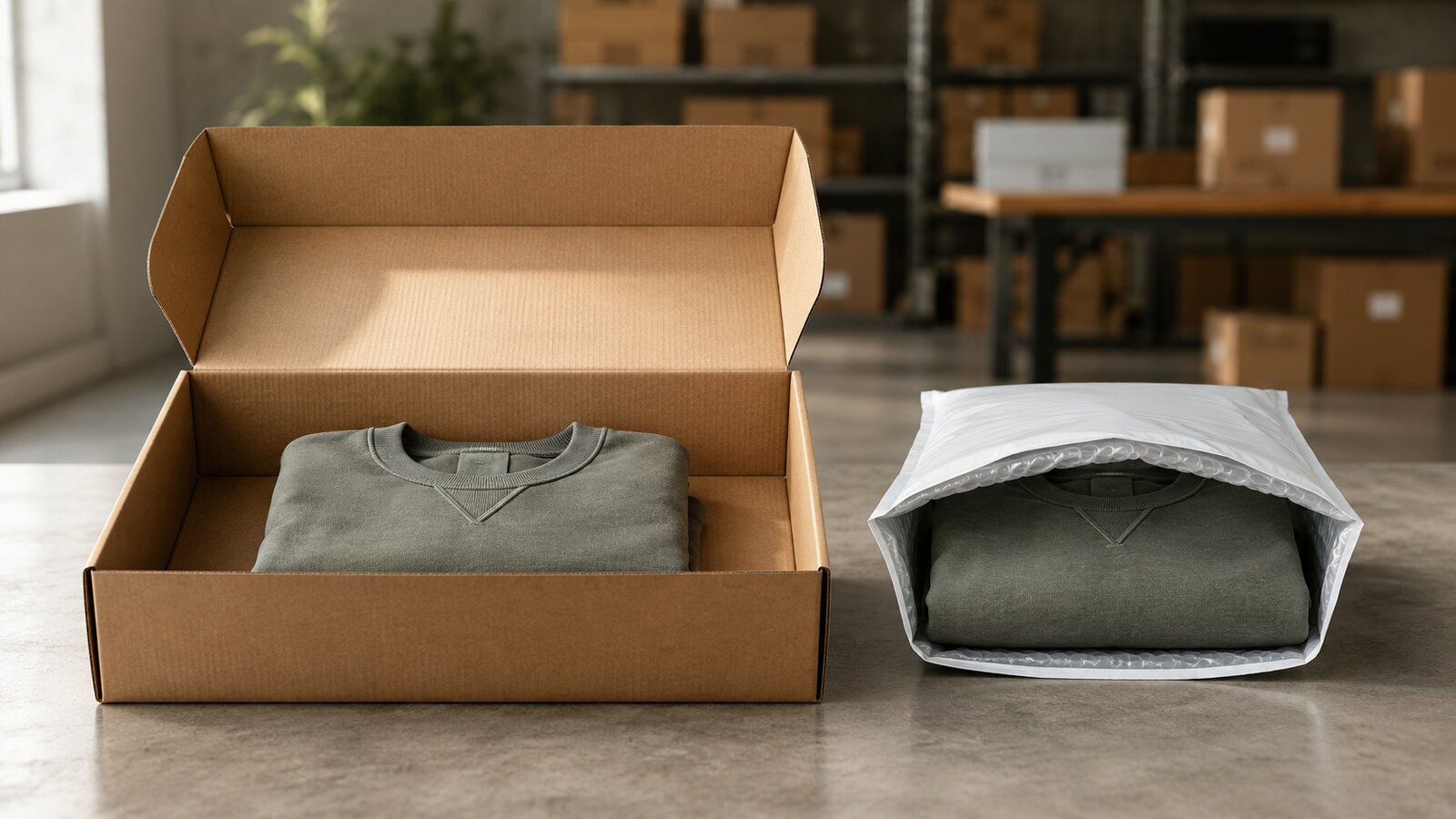
Take a typical order from your activewear store. It is $100. Most often, one premium hoodie. The hoodie weighs one pound. Your warehouse packs every order in the same box: 10 by 10 by 4 inches. You picked it long ago. One box for everything made packing simple.
The carrier does the size math on that box. It bills the order as a three-pound package. So you pay $12 to ship a one-pound hoodie. Now try a box that actually fits the hoodie, 8 by 8 by 2 inches, or a padded mailer. That bills at one pound. It costs $9.
Three dollars. Now look at what those three dollars do to your profit.
Same hoodie, same customer, same carrier, only the box changes
Per order, whole dollars. Standard costs for this store are in the appendix.
| Line item | Big box (today) | Right-sized (after) |
|---|---|---|
| What is inside | 1-lb hoodie | 1-lb hoodie |
| Box size (inches) | 10 x 10 x 4 | 8 x 8 x 2 (or mailer) |
| Weight the carrier bills | 3 lb | 1 lb |
| Shipping cost per order | $12 | $9 |
| Profit left per order (all six costs paid) | $10 | $13 |
| Yearly difference on 20,000 orders | – | +$60,000 |
Read the bottom two rows. This store keeps $10 per order today. Change the box, and it keeps $13. That is a 30% raise on every order. The cost? A two-hour audit and a packaging order. On 20,000 orders a year, that is $60,000.
One honest note. The $3 is a saving, not magic new money. It lands in your pocket only if nothing else changes. And your own number depends on your carrier, your product, and your box. Some brands find $5 an order. Some find their boxes are already right, and find nothing. That is worth knowing too. The table shows why the two-hour check is worth running.
The sentence that changes how you think about packaging
The carrier does not bill you for the hoodie. It bills you for the box.
Every inch of empty air inside the package costs money. That cost repeats on every order. Forever. Right-size the box once, and the saving ships with every future order.
2. How to run your own packaging audit
The audit takes about two hours once you have your shipping data. The output is a short list. Which products move to a smaller box or a mailer. And what that is worth per year.
- Pull the last 30 days of shipments. Get the data from your carrier or warehouse. For each shipment: the real weight, the box size, the billed weight, and the cost. Group it by product. Then you can see what ships in what.
- Divide billed weight by real weight for each product. That number is your warning flag. Above 1.5? The box is probably too big. Above 2? It almost surely is. The hoodie above was at 3.
- Move soft products into padded mailers. Apparel, textiles, and small accessories usually ship perfectly in a mailer. And many carriers bill mailers by real weight only. No size math at all. Check your carrier's rules.
- Build a small family of boxes. One box for everything is exactly what causes the overpayment. Three or four sizes plus a mailer covers most catalogs. Ask your warehouse what they can pack fast. A box change that slows packing eats the saving.
- Test for two weeks, then roll out, and re-check yearly. Ship a slice of orders in the new packaging. Check that the saving shows up on the real carrier invoice. Not just on paper. Then switch fully. Re-run the diagnostic once a year. Products change. So do carrier formulas.
3. One warning before you act
Do not shrink every box. Fragile products need their padding. One broken $80 item can wipe out a year of box savings on that product. And is a premium unboxing moment part of your brand? Then weigh that before you downsize the experience.
The rule: right-size only where the smaller package still protects the product and the experience. Watch your damage rates and packaging reviews for a quarter after the change. Roll back if they slip.
4. Frequently asked questions
How is dimensional weight actually calculated?
Multiply the box's length, width, and height in inches. Divide by the carrier's divisor, usually 139 in the US. Round up to the next whole pound. Our big box: 10 × 10 × 4 = 400. Divided by 139, that is 2.9. Billed as 3 pounds. The right-sized box: 128 ÷ 139 is 0.9. Billed as 1 pound. You pay the higher of that and the real weight.
Do padded mailers really skip the size math?
Often, yes, below a certain size. Many carriers bill mailers on real weight only. But the rules differ by carrier and contract. Check yours before you count on it. Your warehouse account manager will know.
Will my warehouse tell me if my boxes are too big?
Usually not. The carrier's invoice is not their bill. That is why the audit is yours to run. But do bring the warehouse in before you change anything. They know which packaging they can pack fast. They know which carriers treat mailers kindly.
How many box sizes should I stock?
Three or four, plus a mailer. That covers most catalogs. One size causes overpayment. Ten sizes cause packing chaos. A five-product brand might need two. A five-hundred-product brand maybe five.
5. Quick reference: what to avoid and apply
What to avoid
- Shipping every order in the same box, no matter what is inside.
- Thinking shipping cost is about product weight, on light goods it is about box size.
- Skipping padded mailers for apparel and other soft goods.
- Shrinking packaging on fragile products without watching damage rates.
- Running the audit once and never again, catalogs and carrier formulas drift.
What to apply
- Pull 30 days of shipments with real weight, box size, billed weight, and cost.
- Flag any product where billed weight is more than 1.5 times real weight.
- Move soft goods to padded mailers where your carrier bills them by real weight.
- Build a family of three or four boxes with your warehouse's input.
- Test two weeks against the real invoice before full rollout. Re-audit yearly.
Want your six costs mapped for you?
Our free 31-Point Profit Diagnostic puts a dollar figure on where your profit is leaking. Or get a quote for done-for-you eCommerce accounting.
Definitions, modeling notes & rate-basis disclosures
Definitions
- The six profit levers
- (1) Discounts, (2) Refunds, (3) Product cost (landed COGS), (4) Sales channel and payment fees, (5) Shipping and 3PL fees, (6) Advertising spend.
- Dimensional weight
- A billed weight the carrier works out from box size instead of real weight: length × width × height in inches, divided by the carrier's divisor (usually 139 in the US), rounded up to the next whole pound. You pay the higher of real and dimensional weight.
- Right-sizing
- Matching the box or mailer to the product instead of using one stock box for everything.
- Padded mailer
- A soft envelope-style package for non-fragile goods. Often billed by real weight only, below certain sizes.
- Contribution per order
- Selling price minus all six costs. What one sale really leaves behind.
- Third-Party Logistics (3PL)
- The outside warehouse that stores your stock and packs and ships your orders.
Modeling notes
- This article uses the series' standard teaching store: a $100 order, product cost $40, a standing 10% discount, advertising $20 per order, refunds 5%, payment and channel fees 3%, and shipping and 3PL of $12, falling to $9 after the box change. Contribution per order: $10 before, $13 after.
- Dimensional math (carriers round up to the next whole pound): 10 × 10 × 4 = 400 cubic inches ÷ 139 = 2.9, billed as 3 lb. 8 × 8 × 2 = 128 ÷ 139 = 0.9, billed as 1 lb. The hoodie's real weight is 1 lb.
- The $60,000 yearly figure is $3 × 20,000 orders. The saving grows in a straight line with order volume.
- Real carrier rates vary by zone, service level, and contract. The $12 and $9 rates show the mechanic; plug in your own.
Rate-basis disclosures
- Product baseline: one premium hoodie, 1 lb real weight, $100 average order value.
- Current packaging: one stock box, 10 × 10 × 4 inches, used across the catalog.
- Right-sized packaging: 8 × 8 × 2 inch box or padded mailer of similar footprint.
- Carrier divisor: 139 (standard US domestic for major carriers).
- All figures rounded to whole dollars for easy reading.