

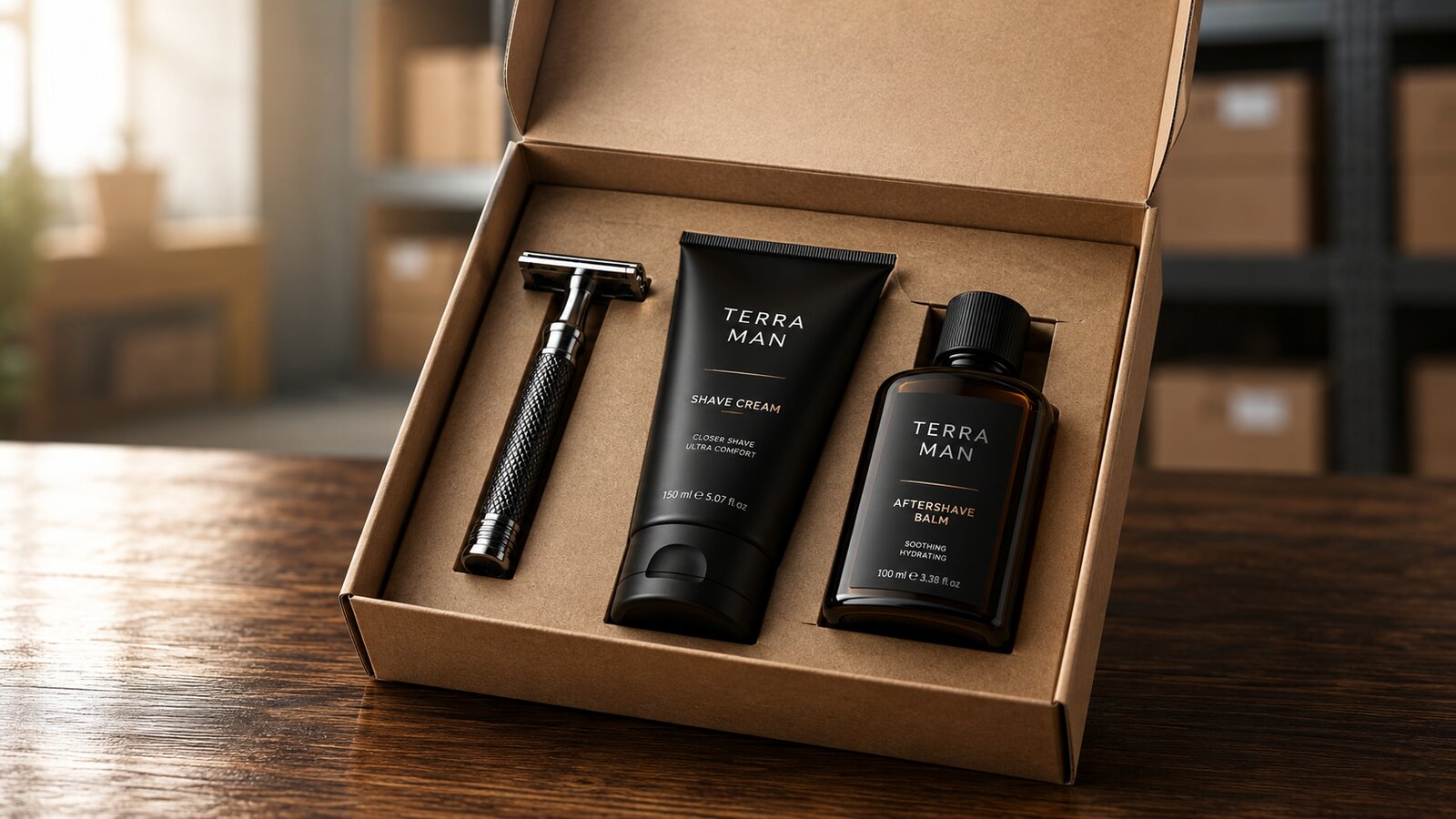
The problem with selling a set as three separate picks
You think of your catalog as a list of products. Your warehouse thinks of it as a list of picks. That warehouse is your Third-Party Logistics (3PL) partner. A customer orders three items. A picker walks to three shelves. And the 3PL bills you three .
Most founders never see this. The invoice shows totals, not walks. The three items end up in one box either way. The customer notices nothing. But a three-line order costs you a lot more to ship than a one-line order for the same money.
Here is the miss. If the same three products keep selling together, that is not three buys. It is one buy split across three listings. And it pays the multi-pick tax on every order. Forever.
This article is about the fifth one: shipping and warehouse fees. Every extra line on an order is an extra pick fee. Turn a repeating three-item order into one bundle, and two of those fees disappear on every future order.
1. An example showing you the numbers
Your store sells men's grooming products. Three star items keep landing in the same cart. A $35 razor. A $30 shave cream. A $35 aftershave balm. Customers treat the trio as a set. The order comes to a tidy $100.
Today that order reaches your 3PL as three lines. A picker makes three trips. The items go into one box. And you are billed $2 per line: $6 in pick fees. That sits on top of a $3 pack fee and $3 of postage. Twelve dollars to ship one box.
The fix is one bundle , a single listing for the trio. The 3PL builds the sets ahead of time, in a quiet hour. So a bundle order triggers one pick instead of three. Same products. Same box. Same customer. Different invoice.
Same three products, same box, one pick instead of three
Per order, whole dollars. Standard costs for this store are in the appendix.
| Line item | Three picks (today) | One bundle (after) |
|---|---|---|
| What the customer gets | Razor, cream, balm | Razor, cream, balm |
| Order lines at the warehouse | 3 | 1 |
| Pick fees ($2 per line) | $6 | $2 |
| Pack fee and postage | $6 | $6 |
| Kitting the bundle in advance | $0 | $1 |
| Shipping and 3PL, total | $12 | $9 |
| Profit left per order (all six costs paid) | $10 | $13 |
| Yearly difference on 10,000 trio orders | – | +$30,000 |
Read the middle rows. Pick fees drop from $6 to $2. Building the bundles ahead costs $1 per set. That is real work, counted honestly. Net saving: $3 per order. Your store keeps $10 on a trio order today. The bundle version keeps $13. That is a 30% raise on every trio order. And it repeats every time the pattern sells. On 10,000 trio orders a year, that is $30,000. All for one new listing and a kitting deal.
One honest note. The saving lands only on orders that would have shipped as multi-line picks. Single-item orders cost what they always cost. And pick fees vary by 3PL. Some contracts make the gap bigger. Some make it smaller. Ranges are in the appendix. The bundle recovers cost on the pattern it captures. Not on your whole store.
The sentence that changes how you think about bundles
Your customers are already telling you which bundles to build. Look at what they put in the cart together.
Every multi-line order that repeats is a bundle waiting to happen. One listing. One pick. One fee. And the saving ships with every future order that fits the pattern.
2. How to find and launch your first bundles
This is a two-hour exercise with data you already have. The output is a shortlist of two or three bundles to build. Rank them by how often the pattern sells and what it saves.
- Pull 90 days of orders with every line shown. Your store's order export has this. Your 3PL portal usually does too. Group by order. Then you can see which products shipped together.
- Count the pairs and trios. Which two products land on the same order most often? Which three? A simple count in a spreadsheet is enough. You are hunting repeats, not doing fancy math.
- Rank the patterns by how often they sell and cart value. A pair on 5% of orders at $50 is a small prize. A trio on a quarter of orders at $100 is a big one. Build only the top two or three. And only patterns that already exist. A bundle you wish customers wanted captures nothing. Let the data pick.
- Model the net saving before you build. Pick fees saved, minus the kitting cost per bundle. Your 3PL can quote kitting per unit. Does kitting eat the whole saving? Then stop. The bundle may still help customers. But it has no shipping case.
- Launch beside the originals, then track the shift. Keep the single listings. Add the bundle at the same combined price, or a touch below. Watch whether it soaks up the multi-line orders. That is where the saving lives. Re-run the count every quarter. Patterns shift, and stale bundles should retire.
3. One warning before you act
Do not force the bundle. Some customers want just the razor this month. They will buy the balm when it runs out. Removing the single listings to push people into a set usually backfires. The lost sales cost more than the pick fees you save. Offer both. Let customers choose.
And talk to your 3PL before you list it. Kitting has to fit how they work. Some warehouses kit cheaply in quiet periods. Others charge more, or build kits slowly. A bundle that runs out because kitting is slow is worse than no bundle at all.
4. Frequently asked questions
How should I price the bundle?
Two clean options. Price it at exactly the sum of the items. Then the whole shipping saving stays with you. Or price it 5% to 10% below the sum. That nudges more customers onto the bundle. You give away a slice of the saving to win it on more orders. Both work. Deep bundle discounts do not.
Should I retire the single products once the bundle launches?
Almost always no. Removing them forces single-item buyers to over-buy or leave. Both cost you more than a pick fee. Keep the single listings. Add the bundle beside them. Let customers sort themselves.
What if kitting costs as much as the pick fees it saves?
Then there is no shipping case. And the numbers told you before you built anything. The bundle might still earn its place. It can lift order size or make buying easier. But judge that separately, with its own numbers.
Does this work on Amazon too?
Yes. Fulfilled by Amazon (FBA) fees are charged per unit. So a trio shipped as one bundled unit costs less than three separate units. Amazon calls these virtual product bundles or multi-packs. The listing often ranks well too. It matches how people already shop the set.
5. Quick reference: what to avoid and apply
What to avoid
- Treating the catalog as single products when the same sets sell together weekly.
- Building bundles around what you wish customers bought, not what they buy.
- Removing single listings to force customers into the bundle.
- Skipping the kitting quote, the saving is net of kitting, not gross.
- Counting cart patterns once and never again, they shift with the catalog.
What to apply
- Pull 90 days of orders and count which products ship together.
- Rank the repeating pairs and trios by how often they sell and cart value.
- Model pick fees saved minus kitting cost before building anything.
- Launch the bundle beside the single listings at the combined price.
- Track whether multi-line orders move over, and re-count every quarter.
Want your six costs mapped for you?
Our free 31-Point Profit Diagnostic puts a dollar figure on where your profit is leaking. Or get a quote for done-for-you eCommerce accounting.
Definitions, modeling notes & rate-basis disclosures
Definitions
- The six profit levers
- (1) Discounts, (2) Refunds, (3) Product cost (landed COGS), (4) Sales channel and payment fees, (5) Shipping and 3PL fees, (6) Advertising spend.
- Stock Keeping Unit (SKU)
- One distinct product listing in your catalog. A bundle SKU is one listing that holds several products.
- Pick fee
- What the 3PL charges for each line it picks on an order. Three lines, three fees. One line, one fee.
- Kitting
- The work of building several products into one ready-to-pick bundle ahead of time. Billed per kit.
- Co-purchase pattern
- A set of products customers keep buying together on the same order. The stronger the repeat, the better the bundle candidate.
- Contribution per order
- Selling price minus all six costs. What one sale really leaves behind.
- Fulfilled by Amazon (FBA)
- Amazon's warehousing and shipping service; its fees are charged per unit shipped.
Modeling notes
- This article uses the series' standard teaching store: a $100 order, product cost $40, a standing 10% discount, advertising $20 per order, refunds 5%, payment and channel fees 3%, and shipping and 3PL of $12 on the three-line order, falling to $9 on the bundle. Contribution per order: $10 before, $13 after.
- The $12 line splits as $6 pick fees ($2 × 3 lines) + $3 pack fee + $3 postage. The bundle costs $2 pick + $3 pack + $3 postage + $1 kitting = $9. Gross saving $4; net of kitting, $3.
- Yearly reconciliation: $3 net × 10,000 trio orders = $30,000. The saving scales with the orders that actually move to the bundle, not with total store volume.
- Working ranges: per-line pick fees commonly run $1.50 to $2.50. Kitting commonly runs $1 to $2 per kit, depending on assembly and volume. Your 3PL contract sets your numbers.
Rate-basis disclosures
- Product baseline: men's grooming trio, razor $35, shave cream $30, aftershave balm $35, ordered together at $100.
- Pick fee: $2 per order line. Pack fee: $3 per order. Postage: $3 per order (small, light box).
- Kitting: $1 per bundle, assembled at the 3PL in scheduled quiet periods.
- Saving per trio order: $4 gross, $3 net of kitting. At 10,000 trio orders a year: $30,000 net.
- All figures rounded to whole dollars for easy reading.