

The problem with air freight as your default
Every inbound shipment trades cost against speed. is cheap and slow, 20 to 45 days from China to the US. is fast and costly, 3 to 7 days, at five to ten times the price per kilogram.
Almost no founder picks air freight on purpose. You place a sea order a little too small. Stock sells faster than you expected. You run out before the next shipment lands. Two choices: lose two weeks of sales, or fly in a top-up. The plane wins, every time.
Once the pattern starts, it repeats every cycle. The cost hides in your books under ‘shipping’, never pinned to a decision. A big slice of your stock travels at the most costly rate there is.
This article is about the third one: product cost. Inbound freight is the biggest slice of landed cost after the factory price. The sea-versus-air choice moves it more than any negotiation will. Every unit that flies instead of sails carries the difference straight out of your profit.
1. An example showing you the numbers
Your store sells a light product for $100, made in China. A packed unit weighs about one kilogram. At house numbers it lands for $40, on the boring route: sea freight, about 50 cents of the $40. After discount, ads, shipping, refunds, and fees, each order leaves $10 of contribution.
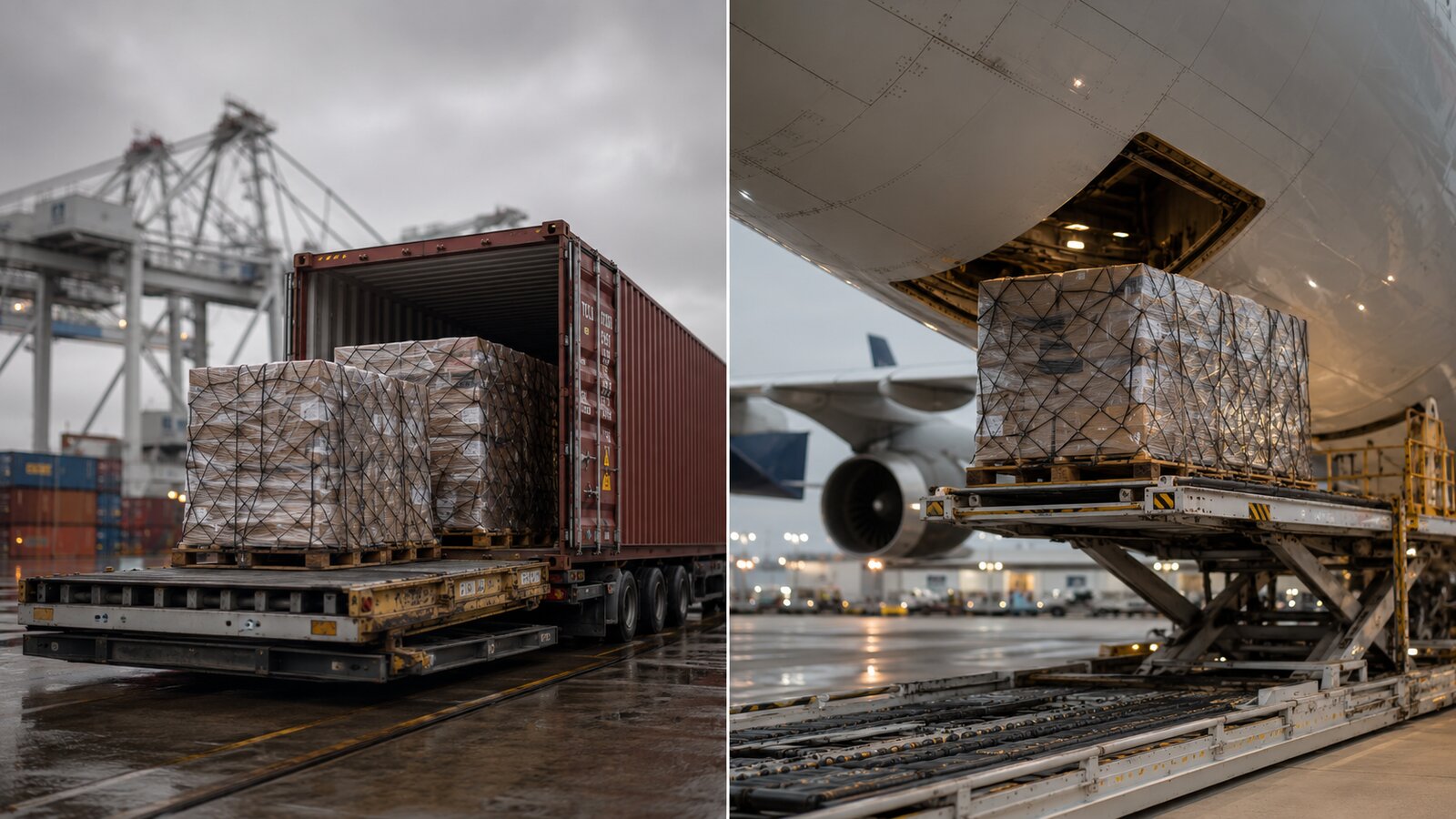
Now fly that same unit. Air freight on this lane runs about $6 per kilogram against 50 cents by sea. The flown unit lands at $45.50. Its contribution drops from $10 to $4.50. One decision, made under stockout pressure, burns more than half the profit of every order it fills.
You import 40,000 units a year, 40,000 kilograms. Thanks to the stockout-and-top-up pattern, half of last year’s volume flew. Here is what that mix cost.
One year of inbound freight, 40,000 units, two mixes
Air at $6 per kilogram, sea at $0.50, 2026 mid-range rates for a China-to-US lane. One unit = one kilogram.
| Line item | Current mix (half air) | Sea as the default |
|---|---|---|
| Units imported per year | 40,000 | 40,000 |
| Units flown | 20,000 | 0 |
| Units shipped by sea | 20,000 | 40,000 |
| Air freight cost (× $6) | $120,000 | $0 |
| Sea freight cost (× $0.50) | $10,000 | $20,000 |
| Total freight for the year | $130,000 | $20,000 |
| Freight saved each year | $0 | $110,000 |
Same product. Same supplier. Same 40,000 units. The half-air mix costs $130,000 a year to move. The all-sea version costs $20,000. The $110,000 gap is exactly the 20,000 flown units × the $5.50 air premium, money that left because the reorder was late.
One honest note. The saving is not free. Sea freight needs enough stock to bridge the longer lead time, roughly 60 to 90 days of cover instead of 30 to 45. Here that is about 5,000 extra units, some $200,000 of stock, funded once. The freight saving repays that in under two years. The stock is still yours. But the cash must exist first.
The sentence that changes how you think about inbound freight
Every urgent air shipment is a problem in disguise, not a freight problem.
You do not fix routine air spend by negotiating with the air forwarder. You fix it by holding enough stock that the sea lead time never causes a stockout, a that fires 60 days out, not 5 days out when the plane is the only option left.
2. How to fix the sea-versus-air mix
Two hours of work once your shipping records are pulled. The output: a reorder plan where sea is the default and air is a choice, not a rescue.
- Pull the last 12 months of inbound shipping records. Every shipment, by product family: mode, cost, and reason, planned reorder, stockout top-up, launch, seasonal spike. Your forwarder or broker can export this in a day.
- Work out your real air/sea split. What share of your stock, by value and weight, moved by air last year? On goods that do not spoil, over 20% air by value says the reorder timing is broken.
- Find the root cause of every air shipment. A viral moment or a launch test is a fair reason. A stockout that repeats every cycle is not. Sort air spend into ‘chosen’ and ‘forced’. The forced pile is the prize.
- Model the deeper stock, then set a reorder trigger. Average daily sales × sea lead time plus a buffer, usually 60 to 90 days of cover. Then set a trigger, about 60 to 75 days, that fires the next sea order on its own. Miss it by a week and you are booking a plane.
- Fund the cash, switch the default, re-audit quarterly. Free the cash first, a catalog cull, better supplier terms, or inventory financing. Then hold deeper stock and let sea carry the routine. Keep 10 to 20% air for launches and true emergencies. Check the mix quarterly.
3. One warning before you act
We are not saying air freight is always wrong. Goods that spoil may have no choice. Light, valuable goods, jewelry, small electronics, carry the air premium easily. New launches deserve a small air test before you fill a container. The goal is not zero air. It is air you chose.
Respect the order of steps too. If the cash for deeper stock does not exist, the freight fix is just a plan on paper. Free the cash first, then switch. Go all-sea with no cash and you land in the worst spot: stockouts and no budget for the rescue flight. Before you change anything, have your forwarder confirm the real rates for your lane.
4. Frequently asked questions
Can I just negotiate my air rates down instead?
You can, and you should. But the gains are small next to the switch. Hard bargaining might take 10 to 15% off air. Moving to sea takes 80 to 90% off. Switch first. Then negotiate what remains.
How do I fund the deeper stock without spare cash?
Three routes. Cull the slow half of your catalog and move the cash. Ask suppliers for net-30 or net-60 terms, the payment cycle funds deeper stock. Or use inventory financing. The freight saving usually covers the credit line several times over.
What is a healthy long-term mix?
For most brands, 80 to 90% sea by value. Keep 10 to 20% air for launches, spikes, and true surprises. Guard against drift, the quiet slide back toward half your goods flying.
What about seasonal peaks like the fourth quarter?
Plan them into the sea order, months ahead. Holiday demand at three times normal belongs in the shipment you book in summer. Flying the December top-up multiplies freight cost in the quarter you can least afford it.
5. Quick reference: what to avoid and apply
What to avoid
- Treating air freight as a free emergency lever, it multiplies the freight cost of every unit.
- Letting the air/sea mix be an accident of reorder timing instead of a decision.
- Sea orders barely big enough to reach the next reorder, that books the next rescue flight.
- Going all-sea before the cash for deeper stock exists.
- Fixing December’s stockout with a plane instead of fixing July’s order with a bigger container.
What to apply
- Pull 12 months of inbound shipping records with mode, cost, and reason.
- Measure the share of inventory that flew, by value and by weight.
- Sort air spend into chosen and forced; attack the forced pile.
- Hold 60 to 90 days of cover and set a reorder trigger that fires early.
- Keep 10 to 20% air for real exceptions, and re-audit the mix quarterly.
Want your six costs mapped for you?
Our free 31-Point Profit Diagnostic puts a dollar figure on where your profit is leaking. Or get a quote for done-for-you eCommerce accounting.
Definitions, modeling notes & rate-basis disclosures
Definitions
- The six profit levers
- (1) Discounts, (2) Refunds, (3) Product cost (landed COGS), (4) Sales channel and payment fees, (5) Shipping and 3PL fees, (6) Advertising spend.
- Landed Cost of Goods Sold (COGS)
- The full cost of one unit in your warehouse: factory price plus freight, insurance, duty, and clearance. Held at $40 on the $100 product, sea freight inside.
- Air freight
- Inbound shipping by cargo plane: 3 to 7 days on major lanes, around $4.50 to $8 per kilogram from China to the US in 2026.
- Sea freight
- Inbound shipping by ocean ship: 20 to 45 days on the same lane, around $0.30 to $0.90 per kilogram for a full container.
- Full Container Load (FCL) / Less than Container Load (LCL)
- Your own container versus shared space. FCL is cheapest per kilogram.
- Stock cover
- How many days your on-hand stock lasts at the current sales rate. A sea rhythm needs 60 to 90 days. Air-rescued brands often run 30 to 45.
- Reorder trigger
- The stock-cover level that fires the next sea order on its own.
- Working capital
- The cash that funds stock between reorders. More cash, deeper stock, and sea freight as the default.
Modeling notes
- This article uses the series’ standard teaching store: $100 price, landed COGS $40, discount $10, advertising $20, shipping and 3PL $12, refunds $5, fees $3, $10 contribution per order. The $40 landed assumes sea freight (about 50 cents of it). Flying adds $5.50, landing the unit at $45.50 and cutting contribution to $4.50.
- Reconciliation: current mix, 20,000 flown units × $6 = $120,000, plus 20,000 sea units × $0.50 = $10,000, total $130,000. All-sea, 40,000 × $0.50 = $20,000. Saving: $110,000 a year, the 20,000 flown units × the $5.50 per-unit air premium.
- Deeper stock: 40,000 units a year is about 110 a day. An extra 45 days of cover is roughly 5,000 units × $40 = $200,000, funded once and repaid by the freight saving in under two years.
- Savings scale in a straight line: half the volume, half the dollars. Rates are 2026 mid-range benchmarks for a China-to-US lane. Your lane, product density, and shipment size move them.
Rate-basis disclosures
- Volume: 40,000 units a year at one kilogram each; $100 selling price, $40 landed cost.
- Air freight: $6 per kilogram (benchmark range $4.50 to $8), China to US, 2026.
- Sea freight: $0.50 per kilogram, full-container equivalent (range $0.30 to $0.90).
- Current mix: 50/50 air/sea by weight. Target: sea as default, 10 to 20% air by value for exceptions.
- All figures in US dollars, rounded to whole dollars.