

The problem with judging a subscription on one order
Many founders see a subscribe-and-save offer. 20% off every order, forever. They kill the idea on the spot. Their standing discount is already 10%. Doubling it for subscribers looks like giving away the store.
That judgment uses the wrong window. A one-time sale is one sale. A subscription is a stream of them. The only fair test is what one customer is worth over twelve months. Not what one order earns this week.
Seen through that window, the picture flips. The deep discount buys you something no campaign can. Month after month of orders you never pay to win again. The first order looks thin. Everything after it is the best money in your store.
This article is about the first one: discounts. A subscription discount is the only discount you give in exchange for a promise. The customer trades a lower price for a repeating order. You trade margin on order one for months of sales with no new ad cost.
1. An example showing you the numbers
Say you sell a premium daily multivitamin on Shopify. A 30-day bottle costs $100. With your standing 10% discount, a one-time buyer pays $90. The order leaves you $10 after all six costs. That includes $20 of ads to win the customer.
Now you add a option: 20% off, delivered monthly. Subscribers pay $80 a bottle. That rate is for them alone. The gap between 10% and 20% makes signing up feel worth it.
Here is what one customer is worth down each path. Watch the advertising line. It is the whole story.
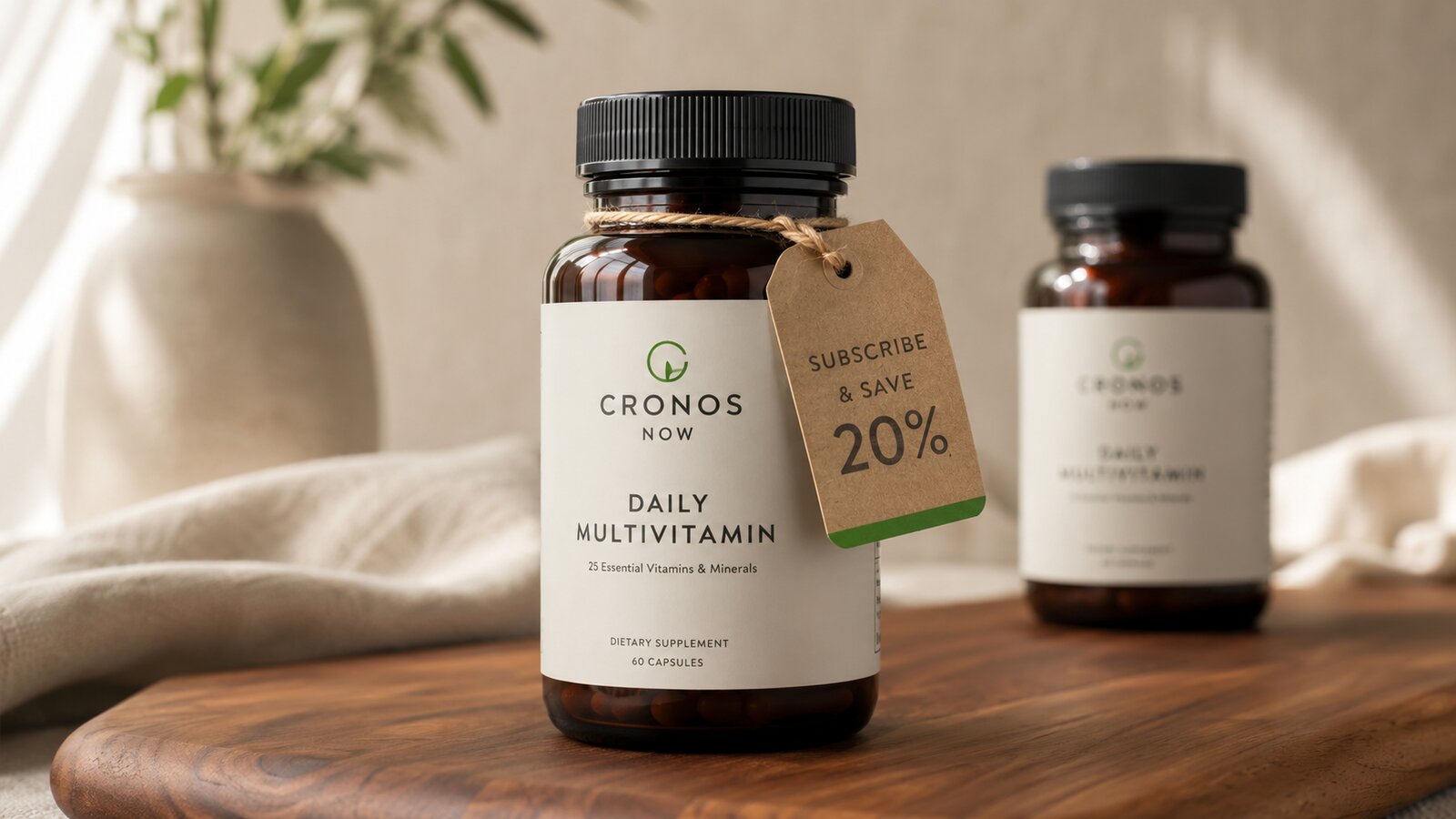
One customer, two paths: buy once at 10% off, or subscribe at 20% off
All numbers in whole dollars. The subscriber column on the right is cumulative, a running total over twelve monthly orders.
| Line item | One-time buyer | Subscriber, order 1 | Subscriber, orders 2-12 (each) | Subscriber, 12-month total |
|---|---|---|---|---|
| Price before discount | $100 | $100 | $100 | $1,200 |
| Discount | -$10 | -$20 | -$20 | -$240 |
| Product cost (COGS) | -$40 | -$40 | -$40 | -$480 |
| Advertising (paid once) | -$20 | -$20 | $0 | -$20 |
| Shipping and warehouse (3PL) | -$12 | -$12 | -$12 | -$144 |
| Refunds (5%) and fees (3%) | -$8 | -$8 | -$8 | -$96 |
| Contribution | +$10 | $0 | +$20 | +$220 |
The subscriber’s first order earns you nothing. The $20 of ads that won the customer, plus the doubled discount, eats the whole margin. Then the machine starts. From order two, there are no ads to pay. Every delivery leaves $20. Double what the one-time buyer left. And the subscriber pays $10 less per bottle.
By month twelve, the subscriber has left $220. The one-time buyer left $10. Even a subscriber who cancels after six orders leaves $100, ten times the single sale. Enroll 500 subscribers in a year. Their first twelve months are worth $110,000. The same people buying once? $5,000.
One honest note. The $220 column assumes nobody cancels for a year. Real life will not do that. Your real number sits between the six-month and twelve-month cases. , how fast people cancel, sets it. The method stands either way. Judge the program on the stream, not the first order.
The sentence that changes how you think about subscription discounts
The first subscription order is not a sale. It is the price you pay for eleven more orders with no ad cost.
In this example, order one earns nothing. And every order after it earns double a normal sale. Why? The customer was won once and never needs winning again.
2. How to price a subscription that pays back
Pricing a subscription takes one evening. You need a spreadsheet and your last 90 days of numbers. The discipline: check the twelve-month math before you look at the sign-up button.
- Reserve your deepest discount for subscribers. Keep the standing discount for everyone else. Give subscribers a clearly better rate. The gap between the two is the sign-up engine. If everyone gets 20%, subscribing offers nothing.
- Set subscribe-and-save between 10% and 20% off. Shallower than 10%, and few customers commit. Deeper than 20%, and order one sinks below zero. It takes longer to claw back. Aim for a first order at or near break-even, like the example above.
- Check the running total breaks even by month two or three. Stack the costs like the table above with your own numbers. Is the subscriber not ahead of a one-time buyer by the second or third order? Then the discount is too deep. Or your ad cost per new customer is too high.
- Make the subscription the default at checkout. Show subscribe-and-save pre-selected, with one-time purchase a click away. Defaults move sign-ups more than any banner. The customer must still see both prices plainly. The point is contrast, not a trick.
- Track retention by monthly cohort, and win back the leavers. A cohort is one month’s group of new subscribers. Watch what share of each group is still active at months three, six, and twelve. A churned subscriber already cost you the ads. A small ‘come back for a month’ offer revives them for almost nothing.
3. One warning before you act
The whole model leans on churn. Say most subscribers cancel after one or two orders. Then the program earns less than plain one-time selling. The doubled discount was spent. The stream never arrived. Do more than about 40% of subscribers quit before their third order? Stop scaling sign-ups. Fix the leak first: the onboarding, the delivery timing, or the product itself.
And subscriptions suit products people finish and reorder. Vitamins, coffee, pet food, skincare. If your product lasts years, do not force it.
4. Frequently asked questions
What if subscribers cancel after one or two orders?
Then each of them earned you less than a one-time buyer. The program is leaking. Look at three things. Did customers know what they signed up for? Does the delivery gap match how fast they use the product? And is pausing easy? People forced to cancel just to pause rarely come back.
My product is not something people use up. Can this still work?
Products people finish and reorder are where subscriptions shine. So be honest about fit. Nobody needs a new set of wooden spoons every month. If your product lasts a long time, people will not order it again and again. So change the offer. Instead of sending the same product, send them something new to try, like a surprise box of new items every three months. That is a different kind of promise to your customer, and the numbers behind it work differently too.
Should I offer an annual prepay option?
Yes, but not on day one. Offer annual at a deeper discount to subscribers who have stuck through three or four monthly orders. They have proven they want the product. Prepaying removes their churn risk. The upgrade converts far better than at sign-up.
What about Amazon’s Subscribe and Save?
It can add volume. But Amazon takes an extra fee on top of its usual charges. And Amazon owns the customer, the data, the renewal, the cancellation. Use it as a side channel if the numbers clear. Build the real program on your own store, where the relationship is yours.
5. Quick reference: what to avoid and what to apply
What to avoid
- Judging the subscription program on order-one contribution alone.
- Giving everyone the subscriber discount, the contrast is the sign-up engine.
- Setting the discount so deep that break-even slips past month three.
- Scaling sign-ups while most subscribers quit before the third order.
- Treating a churned subscriber like a stranger instead of winning them back.
What to apply
- Reserve a clearly deeper discount for subscribers only.
- Price subscribe-and-save at 10% to 20% off, with order one near break-even.
- Model the twelve-month stream with all six costs before launch.
- Make the subscription the pre-selected default at checkout.
- Track cohort retention at months three, six, and twelve, and run win-back offers.
Want your six costs mapped for you?
Our free 31-Point Profit Diagnostic puts a dollar figure on where your profit is leaking. Or get a quote for done-for-you eCommerce accounting.
Definitions, modeling notes & rate-basis disclosures
Definitions
- The six profit levers
- (1) Discounts, (2) Refunds, (3) Product cost (landed COGS), (4) Sales channel and payment fees, (5) Shipping and 3PL fees, (6) Advertising spend.
- Lifetime Value (LTV)
- The total contribution one customer leaves across the whole relationship, not just the first order.
- Customer Acquisition Cost (CAC)
- The advertising spent to win one new customer. In this model, the $20 advertising line, paid once per customer, not once per order.
- Churn
- The rate at which subscribers cancel. The single biggest input to what a subscription program actually earns.
- Cumulative break-even
- The month a subscriber’s running total catches up after the thin first order. Here, month two.
- Subscribe-and-save
- A standing offer of a lower price in exchange for automatic repeating delivery.
- Contribution per order
- Selling price minus all six costs. What one order really leaves behind.
Modeling notes
- This article uses the series’ standard teaching store: a $100 product with COGS of $40, a standing 10% discount, advertising of $20 per order, shipping and 3PL of $12, refunds of 5%, and payment and channel fees of 3%. Business as usual leaves $10 per order. Only the discount lever moves, 10% for one-time buyers, 20% for subscribers, plus the timing of advertising, which is paid once per customer.
- Reconciliation. One-time buyer: $100 - $10 - $40 - $20 - $12 - $5 - $3 = $10. Subscriber order 1: $100 - $20 - $40 - $20 - $12 - $5 - $3 = $0. Orders 2-12: $100 - $20 - $40 - $0 - $12 - $5 - $3 = $20 each. Twelve months: $0 + 11 x $20 = $220; as a column: $1,200 - $240 - $480 - $20 - $144 - $96 = $220. Cancel at month six: $0 + 5 x $20 = $100.
- The $220 figure assumes zero churn for twelve months, a teaching simplification. Model your own program with cohort retention rates; the six-month column shows the shape of a realistic outcome.
- The payoff scaling: 500 subscribers enrolled in a year x $220 = $110,000 of first-year contribution, versus 500 x $10 = $5,000 from the same people buying once.
Rate-basis disclosures
- Product cost: $40 per bottle (40% of the $100 retail price), scaling with order count.
- Discounts: standing 10% for one-time buyers; 20% subscribe-and-save, reserved for subscribers.
- Advertising: $20 per acquired customer, paid on the first order only; $0 on recurring orders.
- Shipping and 3PL: $12 per order, identical for both buyer types.
- Refunds: 5% of retail ($5). Payment and channel fees: about 3% on Shopify (2.9% plus 30 cents), rounded to $3.
- All figures rounded to whole dollars for easy reading.