

The problem with reaching for a discount every time
Founders reach for the same lever every time. A deeper discount. Take 20% off. The customer pays less. The store earns less.
But a discount is a one-to-one trade. Every dollar of saving the customer feels is a dollar of profit you gave up. What they feel is exactly what you pay.
A breaks that trade. The customer values the gift at its retail price. You pay only its cost, usually a small slice of that. Now add a to unlock the gift. Customers make their carts bigger to qualify. Same excitement as a sale. A completely different bill.
This article is about the first one: discounts. And the best discount campaign is sometimes not a discount at all. A gift with purchase creates the feeling of a deal. The price, and your profit, stay standing.
1. An example showing you the numbers
You run a soy candle store on Shopify. Your hero product is a hand-poured candle. It sells for $100. With your standing 10% discount, each order leaves you $10 after all six costs.
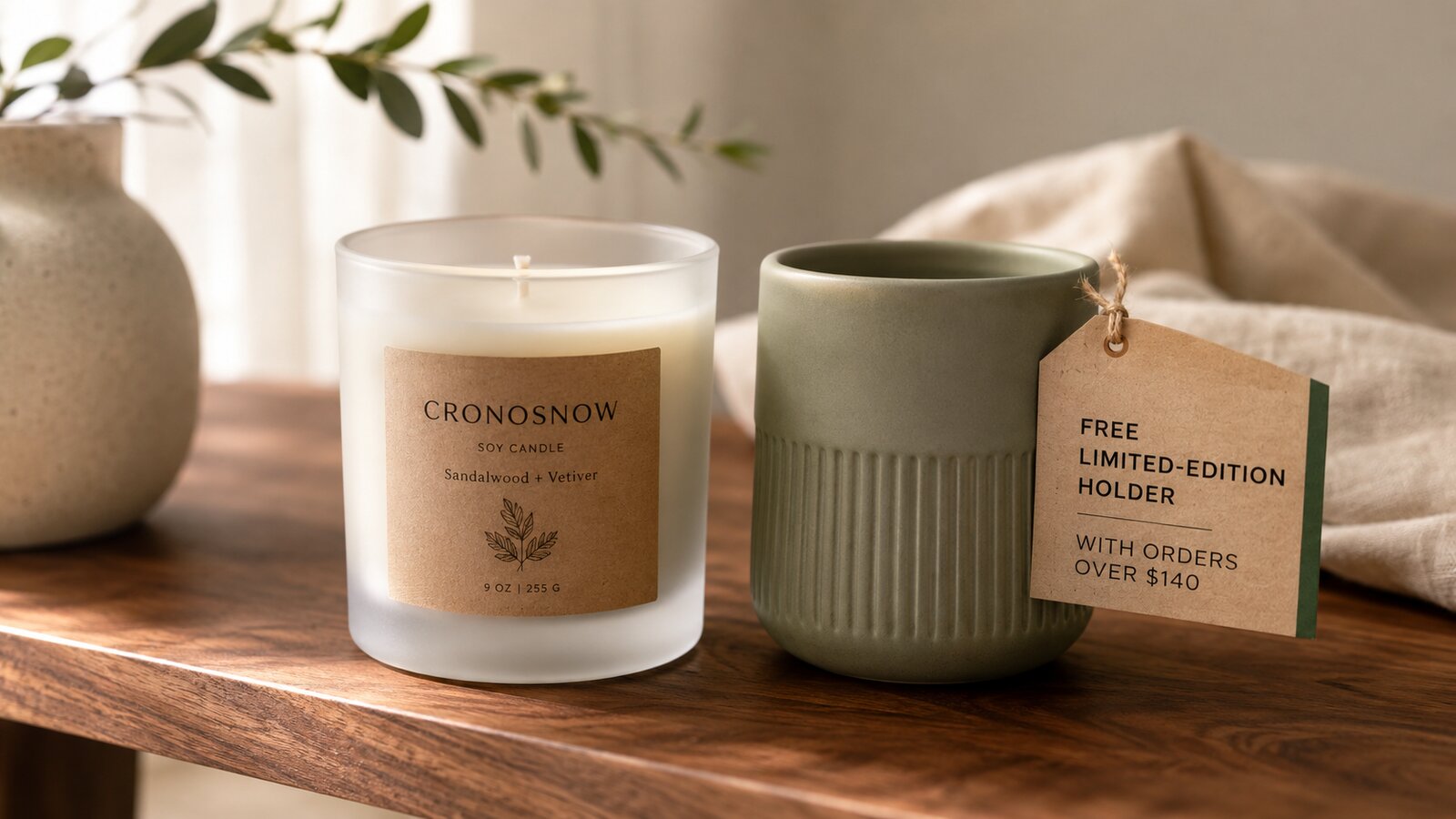
Sales have gone flat. You weigh two campaigns. Option one: drop to 20% off. Option two: hold prices and give a free ceramic holder. It is worth $30 on its own. Free on orders over $140. Your average order is $100. So most customers add a $40 travel candle to qualify.
Here are both options next to business as usual. Plus a twist: the same gift, drawn from stock that gathers dust.
One store, four plays: discount deeper, or give a gift
All numbers per order, in whole dollars. GWP = Gift with Purchase.
| Line item | BAU (10% off) | 20% off sale | GWP, bought gift | GWP, dead-stock gift |
|---|---|---|---|---|
| Cart total before discount | $100 | $100 | $140 | $140 |
| Discount | -$10 | -$20 | -$14 | -$14 |
| Product cost (items bought) | -$40 | -$40 | -$56 | -$56 |
| Cost of the gift | none | none | -$6 | $0 |
| Advertising | -$20 | -$20 | -$20 | -$20 |
| Shipping and warehouse (3PL) | -$12 | -$12 | -$14 | -$14 |
| Refunds (5%) and fees (3%) | -$8 | -$8 | -$11 | -$11 |
| Contribution per order | +$10 | $0 | +$19 | +$25 |
The 20% sale wipes out your profit. Every order works for free. The gift campaign nearly doubles it. The customer got a $30 holder. Plus a candle they were unsure about. You paid $6. The $40 they added to qualify covered that many times over.
The last column is the quiet winner. Say the holder is , already paid for. Then the gift costs you nothing new. And every one shipped clears a unit you were paying to store. Now scale it. 500 orders a month qualify. The bought-gift version earns $9 more per order. That is $4,500 a month. About $54,000 a year.
One honest note. The gift only works if customers truly want it. A gift nobody wants converts nobody. The threshold becomes a hurdle. Test the gift before you print 2,000 of them.
The sentence that changes how you think about gifts with purchase
A discount costs you everything the customer feels. A gift costs you a fraction of what the customer feels.
In this example, the holder feels like $30 to the customer. It costs the store $6. That five-to-one gap, plus the extra item added to reach the threshold, is the whole engine of the campaign.
2. How to design a gift with purchase that pays for itself
Designing a GWP takes one afternoon. Pick the threshold from your data. Pick the gift from your catalog. Model the cart before you announce anything.
- Set the threshold 30% to 50% above your average order. Pull your from the last 90 days. Set the threshold 30% to 50% above it. Close enough that one added item gets the customer there. Far enough that they must add it.
- Pick a gift the customer would keep, display, or use. Not a small sample of what they already buy. A mini candle next to a big candle reads as a tease. A ceramic holder, a wick trimmer, long matches. Accessories that complete the product read as real gifts.
- Source the gift where the cost is lowest. Accessories often cost you 20% of their retail price. So one gift dollar buys five dollars of . Better still, use slow movers already in your warehouse. Their cost is spent. Every gift shipped is a storage fee that stops.
- Anchor the gift’s value everywhere the customer looks. The banner must name the gift, its standalone price, and the threshold: ‘Free limited-edition holder, worth $30, on orders over $140.’ A vague ‘free gift with purchase’ reads as cheap, whatever the gift is.
- Model the qualifying cart, then protect it. Run the full six-cost stack on the qualifying cart, like the table above. Then make sure no extra promo codes stack on top. A discount on the added item gives back the margin that funds the gift.
3. One warning before you act
A gift with purchase does not fit every store. What if your gifts cost half their retail price? The edge shrinks. A simple discount can compete. The play also needs your own store. Amazon has no clean way to tie a free gift to a threshold. So run GWP campaigns on your own site. Use bundles on marketplaces.
Finally, remember: perceived value is not revenue. The $30 the customer feels never lands in your books. Only the cart does. Judge the campaign on . Never on how generous it looks.
4. Frequently asked questions
What makes a gift feel valuable instead of cheap?
Three things. It is something the customer keeps, displays, or uses, not a sample. It has a real standalone price they can check. And it completes the hero product instead of echoing it.
What if I have no dead stock to give away?
Run the bought-gift version. It still beats business as usual, as the table shows. Then seed future gifts on purpose: end-of-season runs, supplier samples, limited-edition overruns.
Can I run a gift and a discount at the same time?
No. The added item carries near-full margin. That margin funds the gift. Stack a promo code on top, and you hand it back. Volume at thin margin: run a discount. Bigger carts at better margin: run the gift.
How is this different from a bundle?
A bundle is one box at one price. Take it or leave it. A GWP lets the customer build their own cart. Then one free item goes on top. Bundles suit repeat buys. Gifts suit stores with accessories, or dead stock that needs a job.
5. Quick reference: what to avoid and what to apply
What to avoid
- Giving a smaller version of the hero product as the gift, it reads as a tease.
- Running a gift with no threshold, the gift cost comes straight off your margin.
- Setting the threshold at or below your AOV, so everyone qualifies without adding anything.
- Letting promo codes stack on top of the gift campaign.
- Describing the gift vaguely instead of naming it and its standalone price.
What to apply
- Set the gift threshold 30% to 50% above your 90-day AOV.
- Choose an accessory that completes the product and feels worth a lot.
- Use paid-for slow movers as gifts to cut the campaign cost to almost nothing.
- Show the gift, its retail value, and the threshold on the product page and in the cart.
- Model the qualifying cart on all six costs before you launch.
Want your six costs mapped for you?
Our free 31-Point Profit Diagnostic puts a dollar figure on where your profit is leaking. Or get a quote for done-for-you eCommerce accounting.
Definitions, modeling notes & rate-basis disclosures
Definitions
- The six profit levers
- (1) Discounts, (2) Refunds, (3) Product cost (landed COGS), (4) Sales channel and payment fees, (5) Shipping and 3PL fees, (6) Advertising spend.
- Gift with Purchase (GWP)
- A free item added to orders above a set cart size. The customer values it at retail; you pay only its cost.
- Qualifying threshold
- The cart size that unlocks the gift, set above your average order so customers add items to reach it.
- Perceived value
- What the offer feels like it is worth to the customer. With a gift, perceived value and your cost are different numbers. With a discount, they are the same number.
- Dead stock
- Inventory that has stopped selling but still sits in the warehouse, already paid for and quietly piling up storage fees.
- Average Order Value (AOV)
- Total revenue divided by number of orders.
- Contribution per order
- Cart total minus all six costs. What one order really leaves behind.
Modeling notes
- This article uses the series’ standard teaching store: a $100 hero product with COGS of $40, a standing 10% discount, advertising of $20 per order, shipping and 3PL of $12, refunds of 5%, and payment and channel fees of 3%. Business as usual leaves $10 per order. Only the discount lever moves here. The gift threshold anchors at $140 (40% above the $100 AOV), reached with a $40 travel candle (COGS $16).
- Reconciliation. BAU: $100 - $10 - $40 - $20 - $12 - $5 - $3 = $10. The 20% sale: $100 - $20 - $40 - $20 - $12 - $5 - $3 = $0. GWP with a bought gift: $140 - $14 - $56 - $6 - $20 - $14 - $7 - $4 = $19. With a dead-stock gift the $6 falls away: $25.
- Deviations from the house card: the gift holder carries accessory-typical COGS of 20% ($6 on $30 retail), not the house 40%. The three-item box ships at $14, not $12. Refunds are 5% of the $140 cart ($7); fees are 3% ($4.20, rounded to $4). A dead-stock gift is treated as $0 marginal cost because its COGS is already sunk; your books still consume the inventory at original cost.
- The payoff scaling: 500 qualifying orders a month at $9 extra contribution each (bought-gift version) = $4,500 a month, about $54,000 a year.
Rate-basis disclosures
- Hero candle: $100 retail, COGS $40 (40%). Added travel candle: $40 retail, COGS $16 (40%).
- Gift holder: $30 retail, COGS $6 (20%, accessory-typical); $0 marginal when drawn from dead stock.
- Standing discount: 10% of the cart in every scenario; the campaign discount in the sale scenario is 20%.
- Advertising: $20 per order, paid once per checkout.
- Shipping and 3PL: $12 single-item box; $14 for the three-item box. Refunds 5% and fees about 3% of the cart, rounded.
- All figures rounded to whole dollars for easy reading.