

The problem with picking an offer before you price it
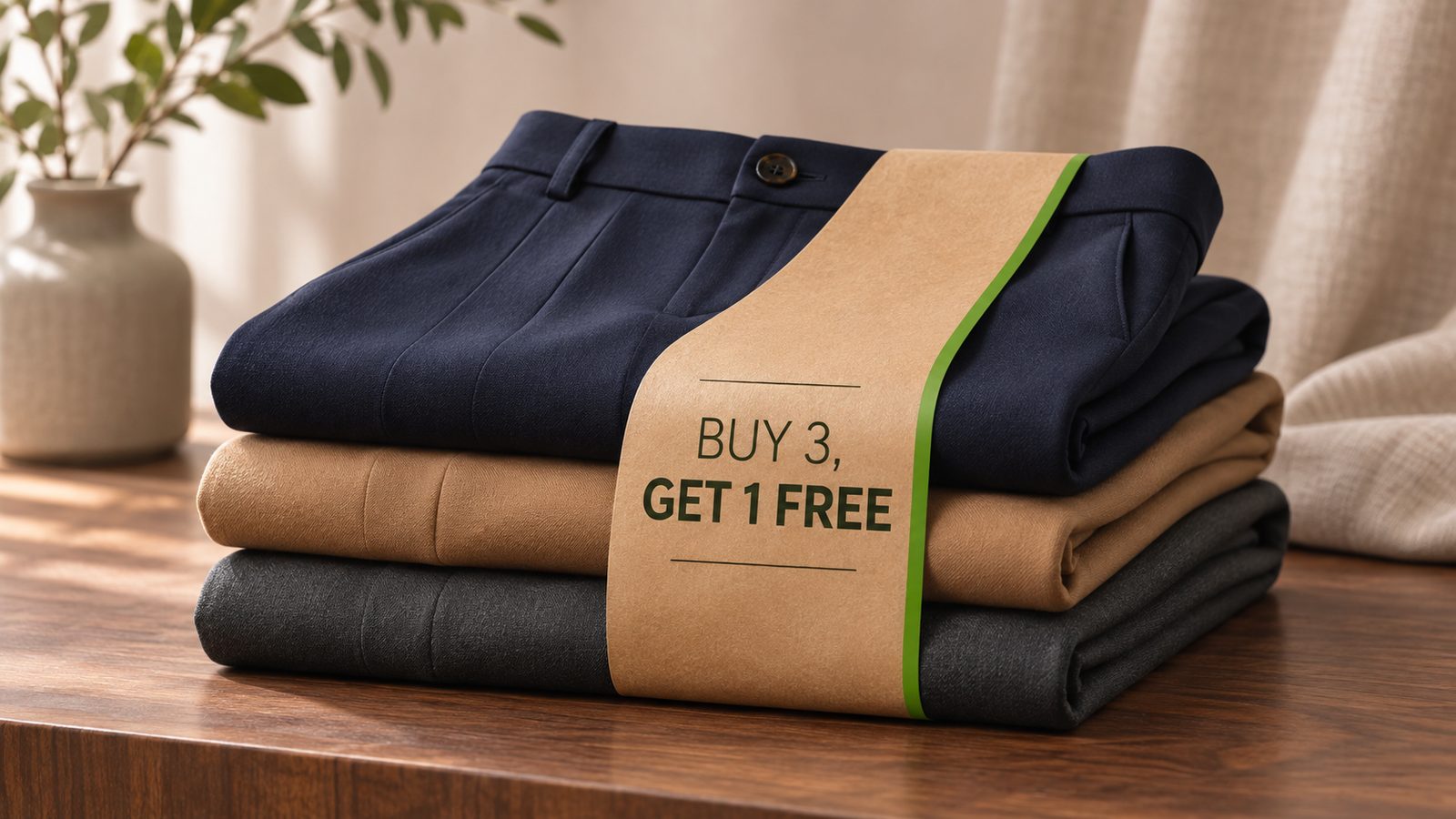
“Buy 3, get the cheapest free” is one of the strongest offers in ecommerce. You may know it as “buy two, get one free.” Shoppers do not see a few dollars off. They see a whole free item. That feels huge, so carts grow fast.
Some founders skip it because free sounds too costly. Others launch it on a hunch. Both miss the point.
This offer is a tool. Like every tool, it fits some jobs and not others. The only way to know is to price it next to your other options, on , before you launch.
This article is about the first one: discounts. A free item is a discount in a different form. On three items at the same price, it is 33% off. That sounds like a lot. In the right store, it pays for itself and then some.
1. An example showing you the numbers
Say you run an apparel store. Your best seller is tailored pants. Every pair is $100. With your standing 10% discount, one pair leaves you with a $10 contribution once all six costs are paid.
Lots of shoppers buy one pair and never come back. So you add an offer: buy 3, get the cheapest free. Three pairs now cost the customer $200. They save $100, and it feels like a real bargain.
But how does this compare with the original 10% discount? Let’s unpack the numbers.
Order comparison: 10% off one pair vs buy 3, pay for two
Per order, in whole dollars.
| Line item | One pair (10% off) | Buy 3, pay for two |
|---|---|---|
| Sales price | $100 | $300 |
| Discount | -$10 | -$100 |
| Product cost (COGS) | -$40 | -$120 |
| AdvertisingStays flat. You already paid to bring the shopper to your store. | -$20 | -$20 |
| Shipping and warehouse (3PL)Only a little more for the bigger order. | -$12 | -$16 |
| Refunds (5%) | -$5 | -$15 |
| Payment and channel fees (3%) | -$3 | -$9 |
| Contribution per orderThe money left over after all variable costs are paid. | +$10 | +$20 |
| Extra contribution from the offer | Baseline | +$10 |
You doubled the money you made on the order. Contribution goes from $10 to $20. The shopper feels they got $100 free. But that pair only cost you $40. Ads and shipping were paid once, and that is where you save the most money.
The healthier your margin, the bigger the win.
So who is this offer for?
It works best in stores where customers usually buy one product at a time. It lifts both order size and contribution.
In a fashion brand we analyzed, 43% of orders held one item, and only about 53% of customers came back. For a buyer who never returns, every extra pair is new money.
So, what is the catch?
The offer has a weak spot. Some shoppers already buy more than one product. For them, bundles or may work better. They smooth out the discount as the order gets bigger.
The sentence that changes how you think about free items
“Buy 3, get one free” is not good or bad. It is a strong tool for one job: turning one-item buyers into bigger orders.
Use it when most orders hold one item and margin is healthy. If most shoppers already buy two or more, a tier discount usually does the job for less. Compare on contribution, then choose.
What a healthier margin does to the offer
In the example above, we showed the value of running a buy 3, pay for 2 promotion. But the question is: what makes it work best for you?
The answer is margin. The bigger the gap between what you pay for a product and what you sell it for, the bigger the impact a promotion like this will have.
Here is why. The free pair only costs you its . In other words, the only real cost of giving a pair away is what it cost you to make and get into your warehouse. So the bigger the gap between what you buy it for and what you sell it for, the bigger the impact.
The two charts below use the same $100 pants and the same store. They show what happens when the landed product cost drops from $40 to $20 a pair. Each chart shows the contribution from three orders:
- One pair, 10% off: your normal order today.
- Buy 3, cheapest free: the same shopper, moved up to three pairs by the offer.
- Three pairs, 10% off: three pairs on your standing discount, for comparison.
Chart 1: product cost of $40 a pair
This is the example above. It shows what each way of promoting the pants leaves you, once all six costs are paid.
Chart 2: product cost of $20 a pair
Same store, same prices. But the product cost has halved, so there is more margin in every pair.
Halving the product cost makes the offer pay five times more
At $40 a pair, the offer adds $10 for every shopper it moves from one pair to three. At $20 a pair, it adds $50. Same pants, same price, same offer. Five times the gain.
Here is why. The free pair costs you only what you paid for it. The bigger the gap between what you pay for a product and what you sell it for, the more margin every pair carries. So each extra pair the offer sells brings in more, and the free one costs you less.
That is the point to take away. The more margin in your product, the harder a promotion works for you. On a thin margin, the same offer barely pays.
2. How to choose the right offer for your store
Plan one afternoon of number work, then 3 to 4 weeks of testing.
- Know your order mix. Pull six months of orders. What share hold one item? How many customers come back? Lots of one-item, one-time buyers is where a free item shines. If 70% or more of orders already hold two or more items, look at a tier discount first.
- Check your margin. A free item costs you its product cost. Run the example above at your own cost. Thin margins leave little room.
- Price every option side by side. Put the free item next to a tier discount, like 10% off two and 15% off three. Run contribution for each kind of shopper you have. The table below shows how.
- Give the free item once per order. Never repeat it. Want to reward even bigger carts? Use a tier for that, not a second free item.
- Test it, then decide. Split your traffic, or run 3 to 4 weeks against a normal stretch with no sale weeks. Judge it on : the profit each store visit brings in. Not Average Order Value (AOV). You want one-item orders to fall. Twos turning into threes is the leak. Keep the offer if contribution per visitor rises and returns hold.
One pair, then three pairs sold three ways
The same $100 pants, compared across the offers you could run. Per order, in whole dollars.
| Line item | One pair (10% off) | Buy 3, get 1 free | Tier: three pairs, 15% off | Three pairs, 10% off |
|---|---|---|---|---|
| Sales price | $100 | $300 | $300 | $300 |
| Discount | -$10 | -$100 | -$45 | -$30 |
| Product cost (COGS) | -$40 | -$120 | -$120 | -$120 |
| Advertising | -$20 | -$20 | -$20 | -$20 |
| Shipping and warehouse (3PL) | -$12 | -$16 | -$16 | -$16 |
| Refunds (5%) | -$5 | -$15 | -$15 | -$15 |
| Payment and channel fees (3%) | -$3 | -$9 | -$9 | -$9 |
| Contribution per orderThe money left over after all variable costs are paid. | +$10 | +$20 | +$75 | +$90 |
| Extra contribution vs one pair | Baseline | +$10 | +$65 | +$80 |
Before you pick an offer: test what shoppers actually buy
Contribution tells you what each order is worth. It does not tell you what shoppers will buy.
The table assumes every offer turns a one-pair shopper into a three-pair shopper. Real shoppers will not all do that. Which offer feels worth more to them? A free pair worth $100? $45 off? $30 off? You can only find out by testing.
An offer that leaves $90 an order is worth nothing if nobody takes it. If 10% off three pairs does not move shoppers from one pair to three, it does not move the needle. You cannot just pick the offer that makes the most per order.
The goal is not the smallest discount or the biggest. It is the point where the discount you give meets real growth in contribution and in products sold. You need both, not one or the other.
Here is the bar each offer has to clear. Free adds $10 for every shopper it moves up. The tier adds $65. So at a $40 product cost, free must move about 6 times as many one-pair buyers as the tier to come out ahead. At a $20 product cost, about twice as many. Your test tells you which one clears it.
3. Three warnings before you act
First, watch shoppers who already buy more. This is where a free item leaks. If most of your orders already hold two or more items, you are paying for sales you already had. A tier discount, like 10% off two and 15% off three, usually works better there.
Second, protect the offer. Never let it stack with first-order or influencer codes. Make it replace your standing discount, not sit on top. And in apparel, put the returns rule in your terms. Shoppers often order three sizes and send two back. The free item is worked out again on what they keep.
Third, make your offers make sense next to each other. Shoppers compare every deal you show them, and they pick the best one. Say your store offers two deals: three pairs at 10% off, or buy 3, get one free. Free wins every time. Now add a third deal: six pairs at 10% off. Why would anyone take it? Two orders of “buy 3, get one free” get them six pairs for $400 instead of $540. Some shoppers will just split the order, or open a second account. Most won’t, but shoppers are not stupid. Each step up should be a better deal than the step before. Random tiers create chaos.
4. Frequently asked questions
Isn’t free too expensive?
Not when the sale is new. A free pair costs you its product cost, $40 here, not $100. For a one-time buyer, the offer doubles what the order leaves. It only gets expensive when shoppers were buying more anyway.
Won’t customers who buy three anyway just get one free?
Some will. That is the leak. If they are a small share of your orders, the one-item buyers you move up can more than cover it. If they are a big share, use a tier discount instead.
Why not buy 6, get 2 free?
Two free pairs in a six-pair cart is 33% off. On this store it leaves $70, against $210 at a flat 10% off. Give the free item once per order. Reward bigger carts with a tier.
Does this work for a store with one product?
It can, but check the math hard. With one price, the free item is always a full third of the cart. Single-product stores often do better with a multi-pack at a modest discount, like the one in Sell a Bundle Instead of a Discount.
5. Quick reference: what to avoid and what to apply
What to avoid
- Launching it without pricing a tier discount too.
- Using it when most shoppers already buy two or more.
- Running it on thin margins without checking contribution.
- Repeating it: buy 6, get 2 free is 33% off.
- Stacking it with first-order or influencer codes.
What to apply
- Check your share of one-item, one-time buyers first.
- Run contribution for every offer and shopper type.
- Choose free for single-item stores with healthy margin.
- Choose a tier when most orders already hold two or more.
- Test on contribution per visitor and keep the winner.
Want your six costs mapped for you?
Our free 31-Point Profit Diagnostic puts a dollar figure on where your profit is leaking. Or get a quote for done-for-you eCommerce accounting.
Definitions, modeling notes & rate-basis disclosures
Definitions
- The six profit levers
- (1) Discounts, (2) Refunds, (3) Product cost (landed COGS), (4) Sales channel and payment fees, (5) Shipping and 3PL fees, (6) Advertising spend.
- Free-item offer
- “Buy 3, get the cheapest free,” also called “buy two, get one free.” One item in the cart costs the shopper nothing.
- Tier discount
- A bigger percentage off as the cart grows, like 10% off two items and 15% off three.
- Perceived value
- What a deal feels worth to the shopper. A free $100 pair feels bigger than $45 off.
- Contribution per order
- Selling price minus all six costs. What one order really leaves behind.
- Cannibalization
- Offer sales that would have happened anyway.
Modeling notes
- Standard teaching store: $100 product, COGS $40, standing 10% discount, advertising $20 per order, refunds 5% and fees 3% of retail per unit ($8), shipping and 3PL $12 plus $2 per extra unit. Business as usual leaves $10 per order.
- Reconciliation. One pair: $90 - $48 - $20 - $12 = $10. Two pairs at 10%: $180 - $96 - $20 - $14 = $50. Three at 10%: $270 - $144 - $20 - $16 = $90. Free-item order: $200 - $144 - $20 - $16 = $20. Tier, three at 15%: $255 - $144 - $20 - $16 = $75. Six pairs, two free: $400 - $288 - $20 - $22 = $70; at a flat 10%: $210.
- Higher-margin check ($20 COGS, all else equal): one pair $30; free-item order $80; tier at three $135. Gain per shopper moved from one pair to three: free +$50, tier +$105 (at $40 COGS: +$10 and +$65). Free must move about 2.1 times as many one-pair buyers as the tier at $20 cost, and about 6.5 times at $40 cost.
- Gains assume a one-time buyer. For a shopper who would have returned, part of the gain is a later order pulled forward.
- The 43% one-item share and 53% repeat rate come from real client analysis. Every dollar figure is a teaching number from the house rate card.
Rate-basis disclosures
- Product: tailored pants for men and women, $100 per pair, mixed colors and cuts.
- Product cost: $40 per pair (40%); higher-margin check at $20 (20%).
- Refunds and fees on full retail per unit, free item included. Whole dollars.